Best Dream Journal & Interpretation Apps in 2026
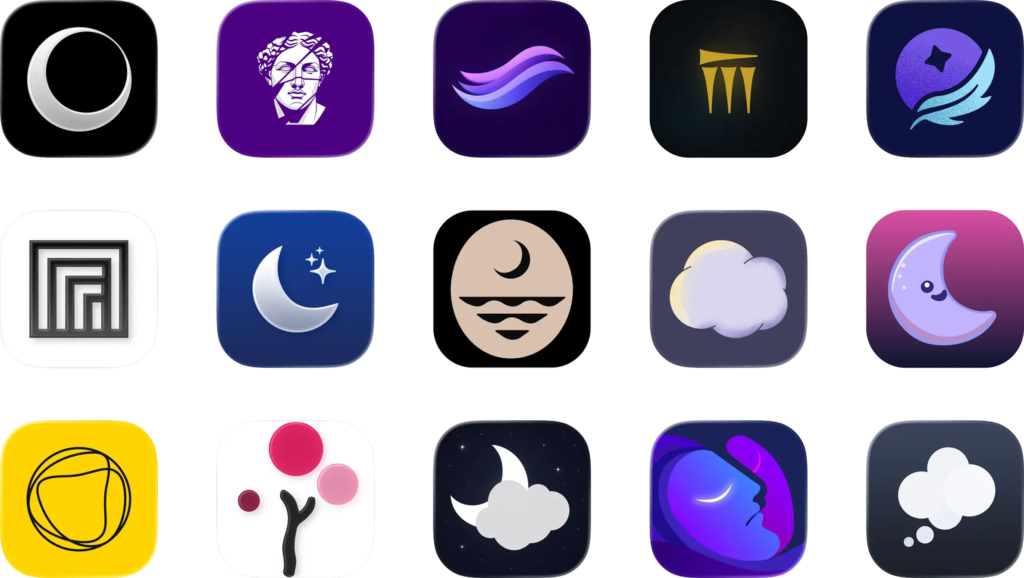
Finding the right dream journal app comes down to speed, privacy, and psychological depth. Most generic apps deliver superficial dictionary definitions that treat your subconscious like a horoscope. To save you time, we tested over 100 dream journal and interpretation apps across capture speed, AI personalization, data ownership, and psychological framework depth. Here are the top 15 dream journal apps ranked for 2026.
Disclaimer: This article is written by the team behind Mirror, the #1 app on this list. We have done our best to write a fair and honest comparison, based on real testing across every app listed here.
What Makes a Great Dream Journal App?
Here is the framework we used to evaluate these apps. These are the five criteria that separate the best dream journal apps from average ones.
Personalized AI Interpretations
Personalized AI Interpretations
Instead of giving you boilerplate dictionary definitions, a great app tailors its analysis to your unique life context. An interpretation that considers your background will always be more relevant than one that reads symbols in a vacuum.
Intuitive & Easy to Use
Intuitive & Easy to Use
Dream memories fade within minutes of waking up. If an app takes too long to load or makes it hard to start writing or recording immediately, you will lose the dream. We disqualified slow, clunky apps that get in the way of fast logging.
Data Ownership
Data Ownership
Your dreams are deeply personal, and you should be able to keep them even if you stop using the app. We only recommended tools that offer clean, full data export in standard formats like PDF, CSV, or plain text.
Privacy by Default
Privacy by Default
A dream journal holds your most private thoughts. Secure biometric locks and a strict no-sale data policy are non-negotiable minimum requirements.
Psychological Depth
Psychological Depth
The analysis must be built on established psychological frameworks like Jungian therapy, cognitive theory, or IRT, rather than relying on generic web-scraped definitions and vibes. A true self-discovery tool acts as a structured mirror, helping you translate symbols into active psychological growth.
1) Mirror: Best Dream Journal App Overall
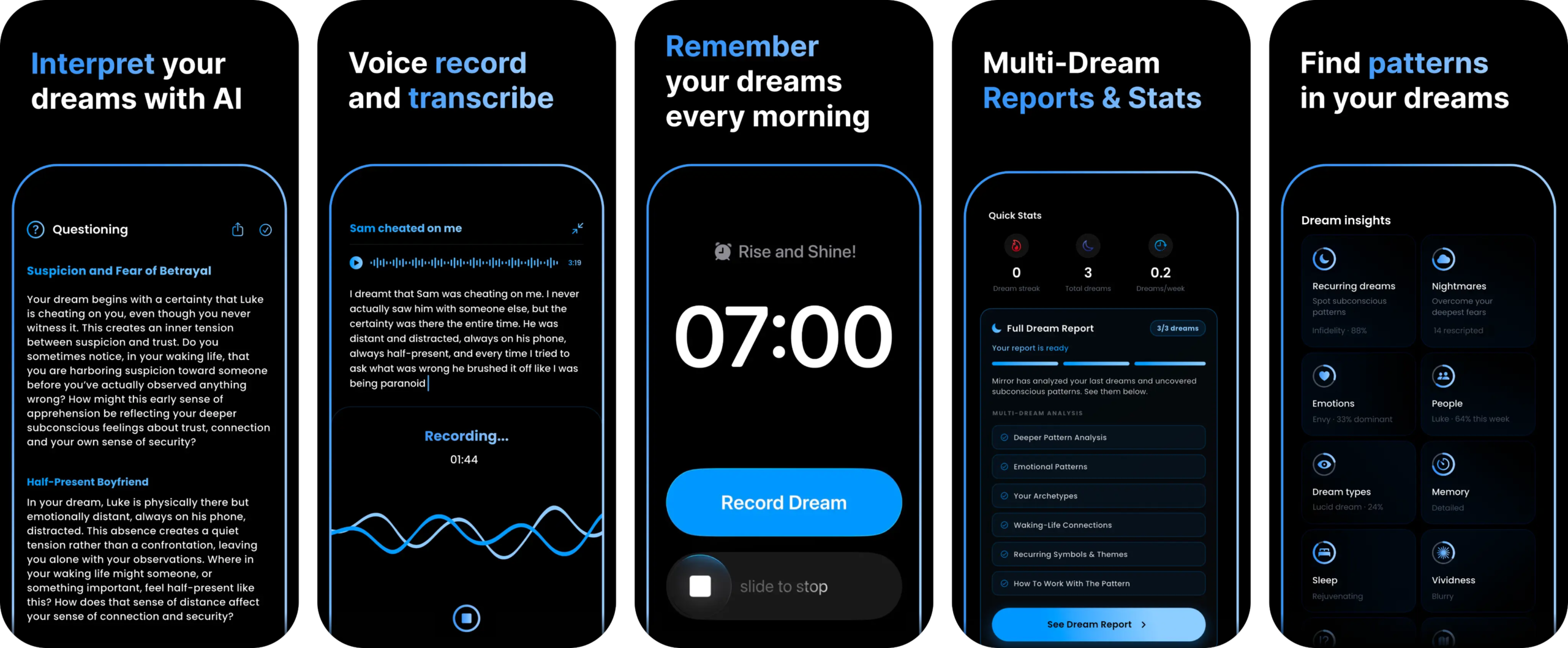
Mirror is the best dream journal app for people who want more than a blank text box and generic meanings. The journaling experience is the simplest and most intuitive of any app we tested: you write or voice-record your dream, and Mirror automatically detects the emotions, people, places, and symbols within it. But where Mirror truly stands apart is the way it understands your dreams: it never treats them as isolated events, it connects them directly to who you are, what you’re going through, and all of your past dreams. If you want to truly understand what your dreams mean, Mirror is the app built for that.
Explore Your Dreams With Mirror
Understand what your dreams really mean for you, in the unique context of your life and personality. Record all the details of your dreams, unlock personalized AI analysis, track your dreams over time, and much more inside the Mirror app.
Dive Deep with the AppKey Features
- Personalized AI Dream Interpretation: Mirror delivers the most deeply personalized dream interpretation of any app available. It interprets every dream by factoring in everything it has learned about you over time, including your relationships, personality, values, insecurities, and past dreams, so each analysis reflects your actual life rather than a generic symbol chart.
- Multi-Dream AI Analysis: Mirror synthesizes patterns across multiple dreams simultaneously. Instead of analyzing each dream in isolation, it identifies repeating symbols, shifting emotional arcs, and deepening psychological threads that connect your recent dreams to each other and to your waking life.
- Living Psychological Profile: With every dream you journal, Mirror uncovers insights and saves them into your Mirror Profile. It organizes the key people in your life, your personality patterns, your insecurities, and your unique life context into a structured profile that grows more accurate over time, so every new dream is interpreted in the full context of your inner world.
- Dream Recall Tools: Morning alarms with 14 wake-up sounds open directly into the dream journal with one tap. You can type or voice-record your dream using real-time on-device speech-to-text transcription that works offline with zero delay. There are also 8 guided dream recall meditations designed to help you remember more dreams and fall asleep faster.
- Dream Statistics Dashboard: Tracks all the emotions, people, places, objects, colors, and recurring symbols across your entire dream history. Quantitative sliders measure vividness, weirdness, and recall quality over time, giving you a clear visual map of how your subconscious evolves week to week.
- Lucid Dreaming Academy: A complete 12-lesson course covering every major lucid dreaming technique, from beginner methods like MILD and WBTB to advanced protocols like WILD, FILD, and SSILD. Includes 5 built-in reality check tools, customizable reality check reminders, and guided intention audio tracks to build the awareness needed to wake up inside your dreams.
- Evidence-Based Inner Work Methods: Beyond AI analysis, Mirror includes structured therapeutic exercises grounded in clinical research. Free Association surfaces hidden subconscious connections. Active Imagination lets you re-enter a dream scene and dialogue with dream figures. Nightmare Rescripting, based on Imagery Rehearsal Therapy, walks you through a 5-phase process to rewrite and resolve recurring nightmares.
Pros
- Interpretations That Actually Resonate: Your results feel like they are about your life, not a copy-pasted horoscope. Every analysis reflects your actual relationships, struggles, and history.
- Personal Growth: The way Mirror builds your psychological profile over time gives you a clear window into what is going on beneath the surface, helping you grow from your dreams rather than just read about them.
- Resolve Recurring Nightmares: Structured therapeutic exercises help you rewrite distressing dream patterns and process waking anxiety directly inside the app.
- You Remember More Dreams: Guided pre-sleep meditations and one-tap morning capture help you recall more dreams within your first week of use.
- See Your Patterns Clearly: Visual dashboards reveal emotional and symbolic trends across your dream history that you would never catch on your own.
Cons
- Requires an active network connection for real-time AI profile synthesis.
- High-commitment profile setup might feel elaborate for users looking for a simple text pad.
Platforms, Pricing & Vibe
- Platforms: iOS, Android
- Pricing: Free (1 interpretation/day) | Premium: $7.99/month · $49.99/year · $34.99 first-year offer
- Vibe: The sanctuary you actually come back to.
Who It’s For
Ideal for individuals seeking the best dream journal app for deep self-discovery and profile-driven analysis. If you want a personal dream interpretation app that connects night symbols directly to your waking relationships, history, and psychological growth, Mirror is the definitive choice.
Verdict
Mirror is the most complete and psychologically grounded dream journal app in 2026. If you want to go beyond simple record-keeping and actively use your dreams for personal growth and self-discovery, Mirror is the definitive choice.
Criteria Breakdown Matrix (15 Apps Evaluated)
| App Name | Personalized AI | Intuitive UX | Data Ownership | Privacy First | Psychological Depth | Compliance |
|---|---|---|---|---|---|---|
| Mirror | ✓ | ✓ | ✓ | ✓ | ✓ | 5/5 (ALL 5) |
| Hypnos | ✗ | ✓ | ✓ | ✓ | ✓ | 4/5 |
| Know Your Ethos | ✓ | ✗ | ✓ | ✓ | ✓ | 4/5 |
| Temenos Dream | ✗ | ✓ | ✓ | ✓ | ✓ | 4/5 |
| Everi | ✗ | ✓ | ✓ | ✓ | ✗ | 3/5 (iOS) |
| DreamApp | ✗ | ✓ | ✓ | ✓ | ✗ | 3/5 |
| DreamMuse | ✗ | ✓ | ✓ | ✓ | ✗ | 3/5 |
| Dreams | ✗ | ✓ | ✓ | ✓ | ✗ | 3/5 (iOS) |
| Lucidity | ✗ | ✓ | ✓ | ✓ | ✗ | 3/5 |
| DreamWell | ✗ | ✓ | ✓ | ✓ | ✗ | 3/5 |
| Oniri | ✗ | ✓ | ✓ | ✓ | ✗ | 3/5 |
| Elsewhere | ✗ | ✓ | ✓ | ✓ | ✗ | 3/5 |
| Dreamboard | ✗ | ✗ | ✗ | ✗ | ✗ | 2/5 (Legacy) |
| Dream Journal Ultimate | ✗ | ✗ | ✓ | ✗ | ✗ | 2/5 |
| DreamStream | ✗ | ✓ | ✗ | ✓ | ✗ | 2/5 |
Start Exploring Your Dreams Today
Understand what your dreams really mean for you, in the unique context of your life and personality. Record all the details of your dreams, unlock personalized AI analysis, track your dreams over time, and much more inside the Mirror app.
Install Mirror App2) Hypnos
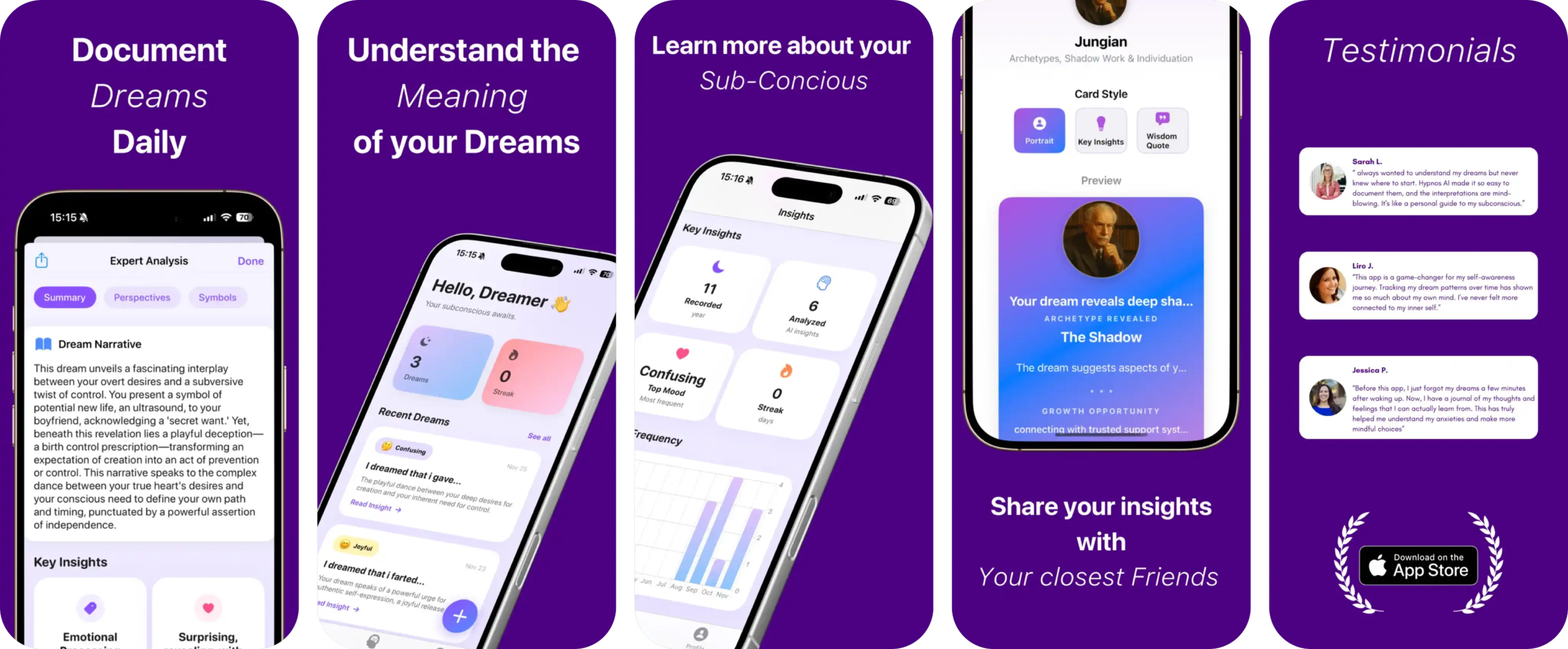
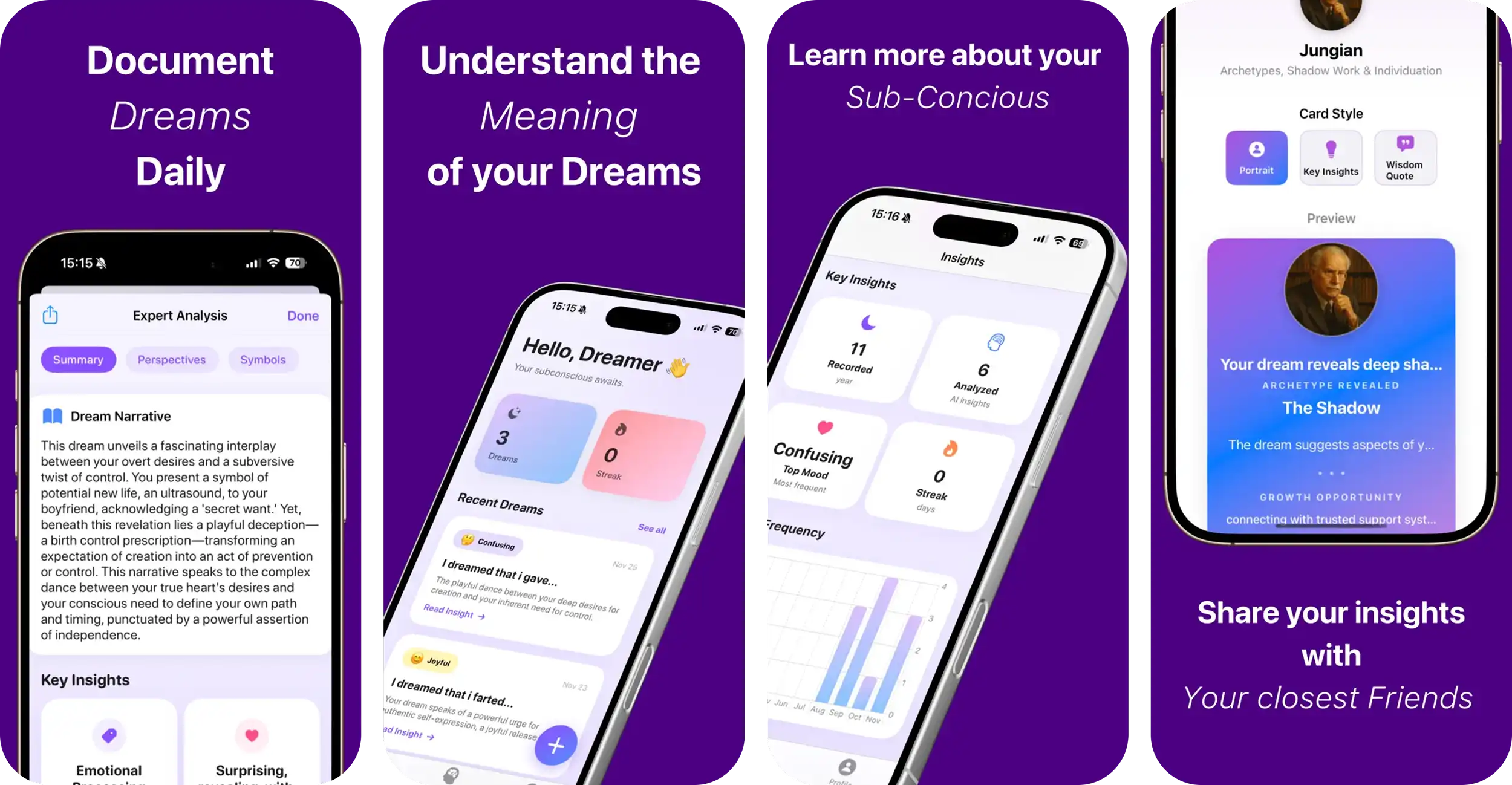
Hypnos offers something genuinely useful: four simultaneous psychological frameworks, Jungian, Freudian, Cognitive, and Modern, applied to every dream. It is intellectually rich. If you have ever wanted to know what Freud and Jung would each make of the same dream, this is your app.
But here is the limitation that matters: Hypnos builds its context from your dream history, not from a profile of who you actually are. It learns you backward, over time, rather than meeting you where you are from day one. The interpretations are consistently thoughtful, but they feel like they could have been written for anyone.
Compared to Mirror: Hypnos offers breadth (multiple lenses). Mirror offers depth (one lens shaped entirely around you). For most users, depth wins.
Pros
- Fascinating multi-perspective AI interpretations.
- Scaffolded prompt system that helps you write when you have writer’s block.
Cons
- No Android app available.
- No active therapeutic exercises (no nightmare rewriting or active imagination).
- Personalization is passive, building context based on past dreams, but lacks a dedicated psychological profile intake.
Platforms, Pricing & Vibe
- Platforms: iOS
- Pricing: Freemium (subscription for advanced features)
- Vibe: The academic’s notebook.
Who It’s For
Built for psychological enthusiasts who want to analyze entries through four traditional theoretical lenses. It serves as a solid dream interpretation app for users who enjoy exploring Jungian, Freudian, and cognitive frameworks without setting up a personal intake profile.
3) DreamStream
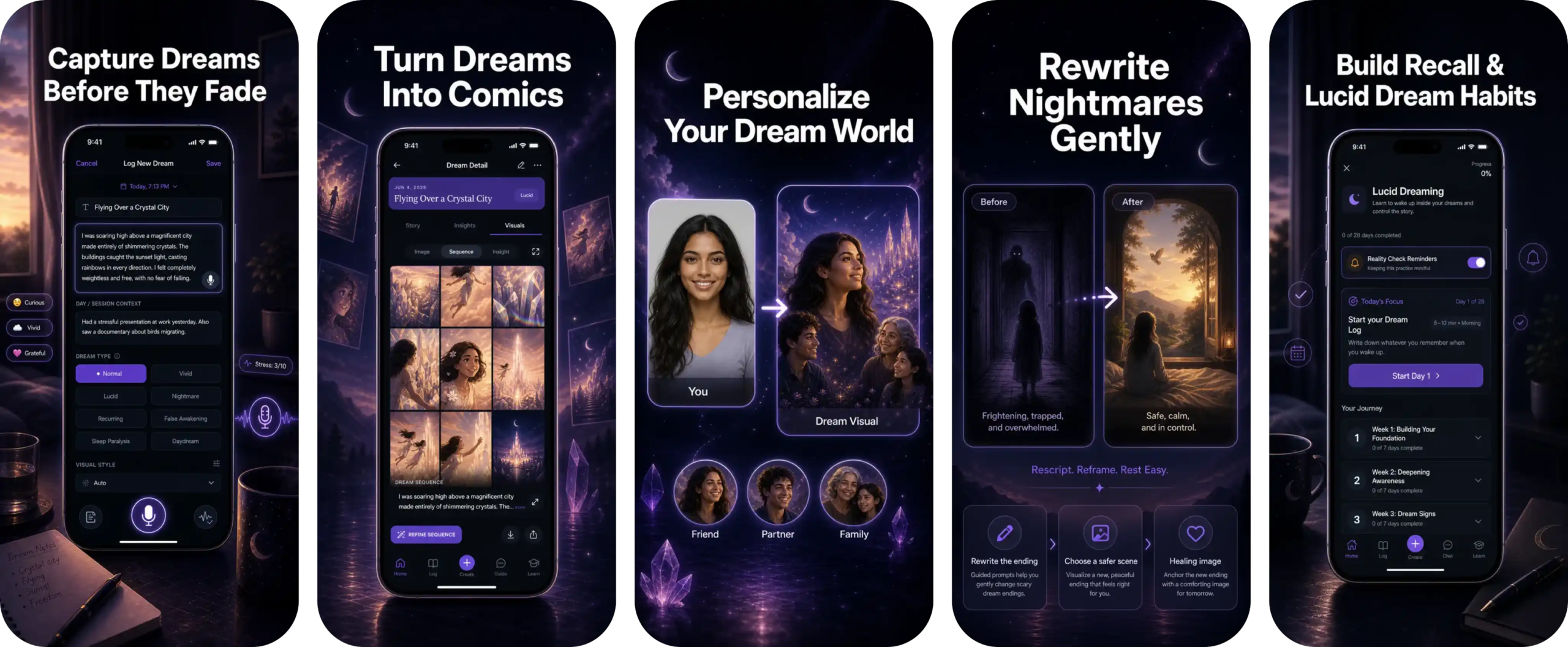
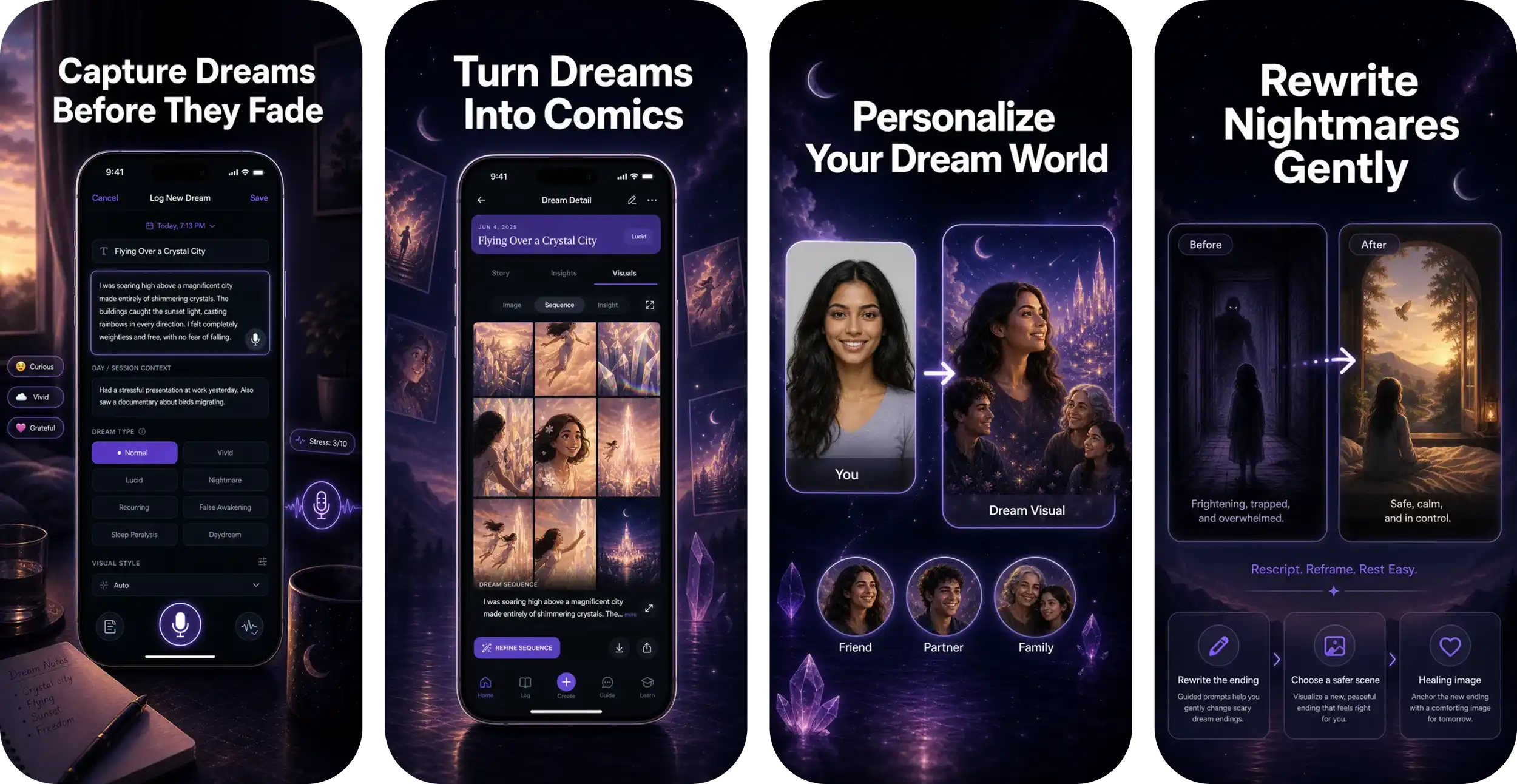
DreamStream is the most visually impressive app on this list. Its voice-first capture is genuinely excellent, built for half-asleep dictation, with fast transcription that doesn’t fumble. The visualization engine is in a class of its own: comic-strip sequences, short dream videos, annotated symbol art.
But visual beauty and analytical depth are not the same thing. DreamStream knows what your dream looks like. It doesn’t ask what it means to you specifically.
Compared to Mirror: If you want to see your dream, DreamStream. If you want to understand it, Mirror. The two apps aren’t competing, they are answering different questions.
Pros
- Superb voice capture UX, highly optimized for immediate waking use.
- Unrivaled visual output (comics, videos, annotated art).
- Clinically backed IRT tool for nightmares.
Cons
- No Android version.
- Uses a credit-based subscription model that can feel restrictive and expensive for power users.
- Personalization is derived strictly from historical tags, without a structured user profile.
Platforms, Pricing & Vibe
- Platforms: iOS
- Pricing: Freemium with credits | Pro ~$9.99/month | Premium ~$19.99/month
- Vibe: The storyteller.
Who It’s For
Tailored for creative thinkers looking for a visual dream journal app that generates AI comic panels and art representations of their morning logs. It works well if your primary goal is visual storytelling rather than personalized psychological analysis.
4) Know Your Ethos
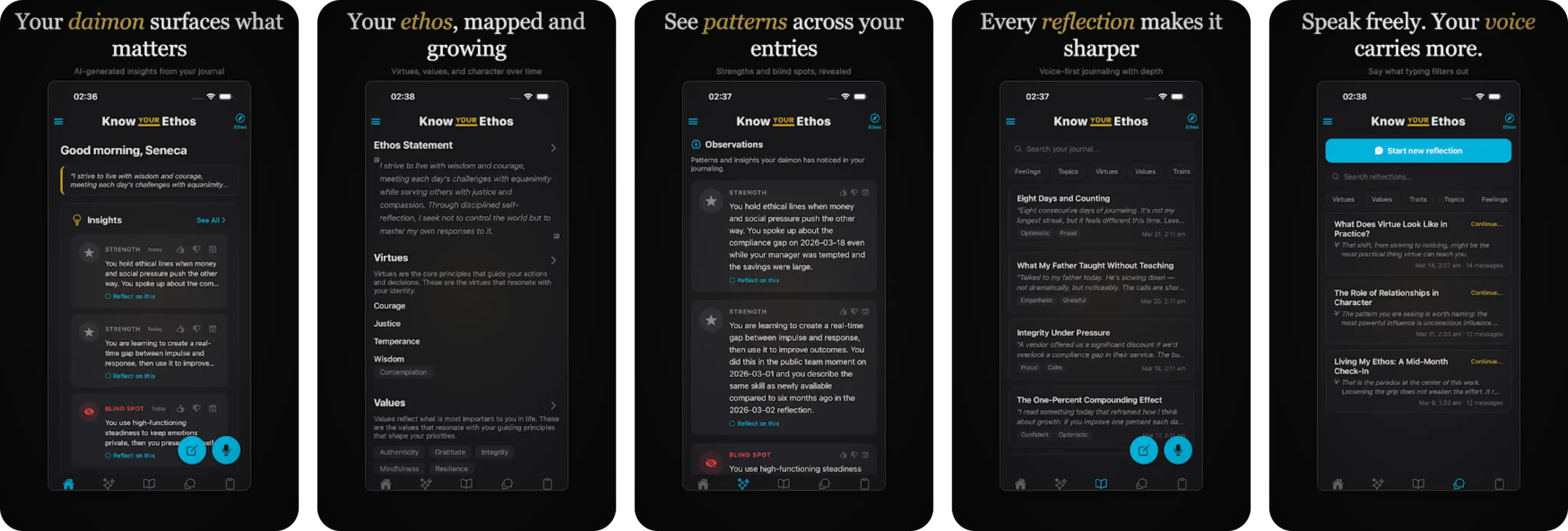
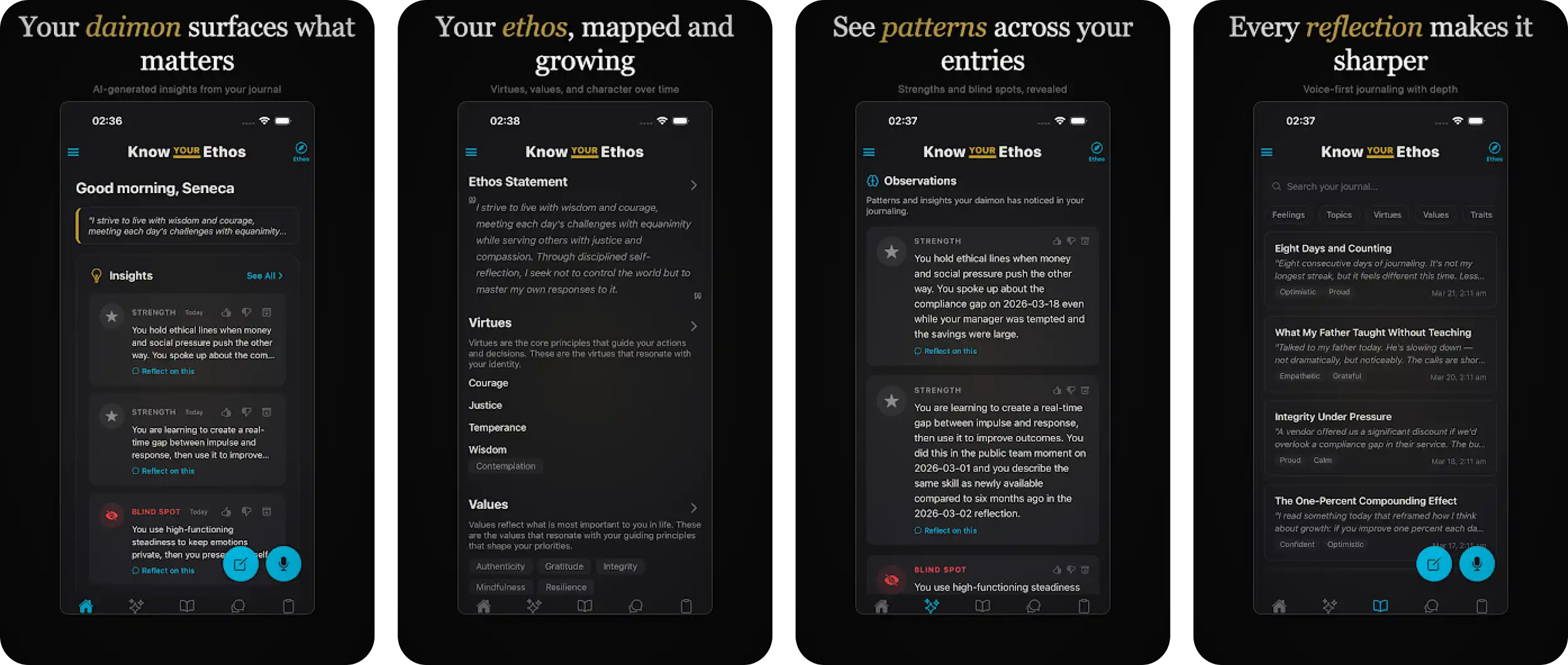
Know Your Ethos (KYE) is not technically a dream journal. It is a self-knowledge system that accepts dreams as one of several inputs. Its six core psychological assessments build a permanent psychological portrait, and an AI called the Daimon then weaves your dream logs, waking reflections, and daily events into a holistic reading of your psyche.
The Daimon conversations are genuinely remarkable. But the app requires constant, high-commitment engagement with your waking life journaling to produce dream insights, which means it asks more of you than it gives on lighter days.
Compared to Mirror: KYE integrates your waking life into your dream analysis. Mirror integrates your entire psychological history. Both are excellent. KYE is for those who want to journal everything; Mirror is for those who want to go deep on the dream specifically.
Pros
- Superb integration between waking life journaling and dream analysis.
- Highly developed psychological profiling system.
- “Daimon” conversations feel deeply reflective, not generic.
Cons
- Lacks dream-specific features (no dream art, no lucid dreaming tools, no dedicated symbol dictionaries).
- Requires a high commitment to general journaling to get the most out of the dream connections.
Platforms, Pricing & Vibe
- Platforms: iOS, Android
- Pricing: Free to start | Premium: $9.99/month
- Vibe: The philosopher’s companion.
Who It’s For
Suited for dedicated self-reflection practitioners who want an all-in-one life tracking system. It operates as a holistic dream journal app for users willing to complete extensive psychological intakes and waking life check-ins.
5) Oniri
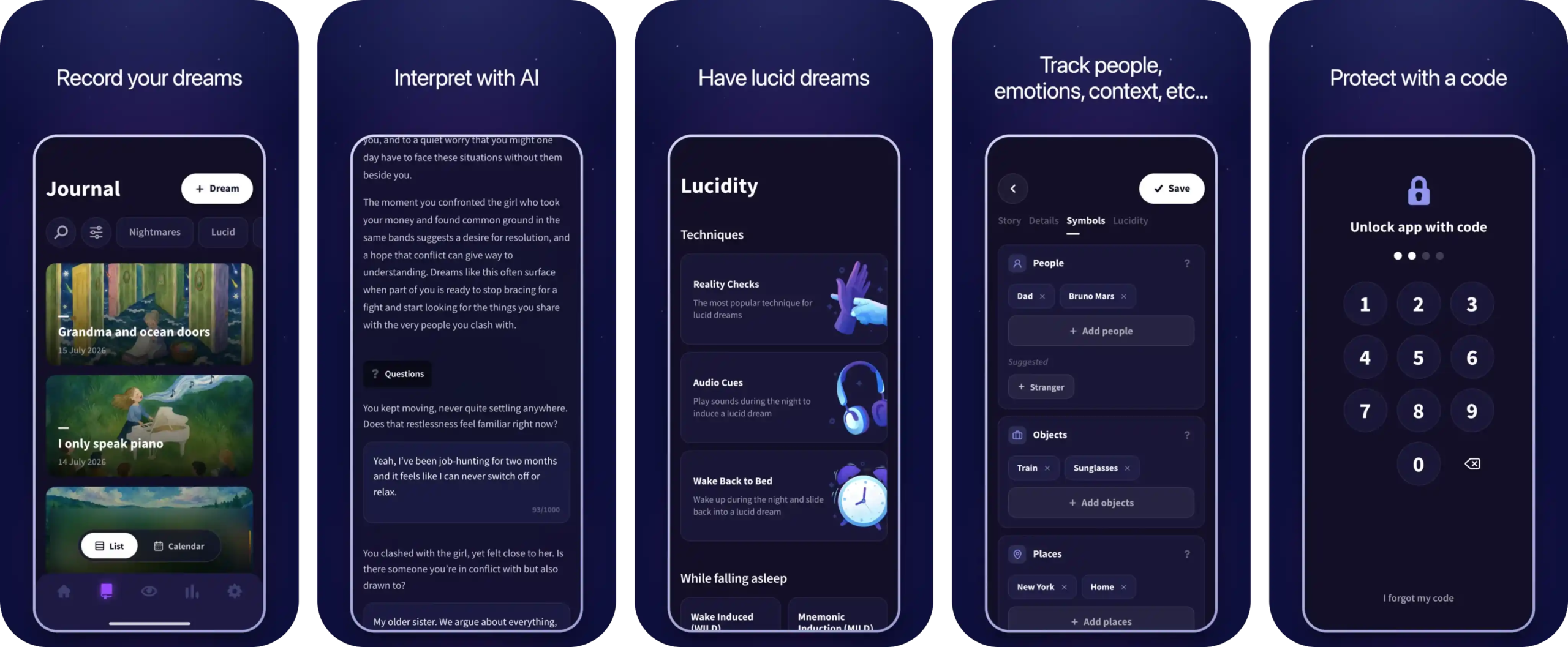
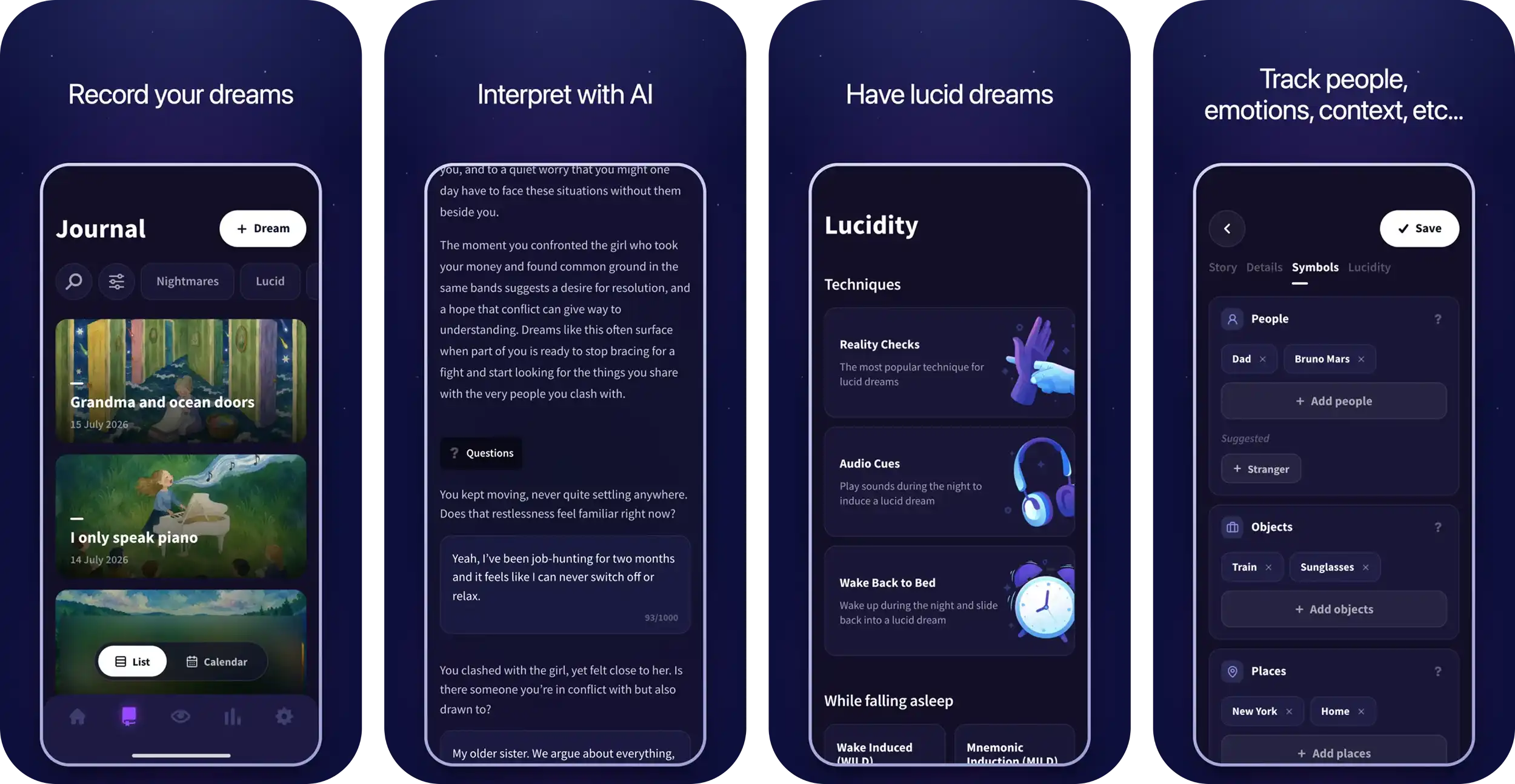
Oniri has been around since 2015, and it feels like it. Not in a dated way, but in a refined way. The interface is crisp, the metadata system is thorough, and the lucid dreaming toolkit (reality-check reminders, nighttime audio cues, hand-drawn dream images) is the most polished of any app tested. It knows what it is and does it exceptionally well.
What it is, however, is a tracker. It doesn’t try to interpret who you are or why you dreamed what you dreamed. It helps you get conscious inside the dream, nothing more, nothing less.
Compared to Mirror: Oniri and Mirror are not rivals. Oniri helps you enter the dream lucidly. Mirror helps you understand what you find there. Some users will want both.
Pros
- Outstanding tools for lucid dream induction (audio cues, reality checks).
- Smooth, highly responsive Swiss-designed UI.
- Excellent data export formats (PDF, CSV, TXT).
Cons
- Almost all core features (including AI interpretations and voice recording) are gated behind a high subscription fee.
- Adding tags and dream metadata feels highly manual and clinical.
Platforms, Pricing & Vibe
- Platforms: iOS, Android
- Pricing: Freemium | Premium: $11.99/month · $70.99/year
- Vibe: The Swiss watch.
Who It’s For
Designed specifically for active lucid dreamers who need specialized training cues, reality check alarms, and audio induction tools. It stands out as a focused lucid dream journal app for building conscious dreaming habits.
6) Elsewhere
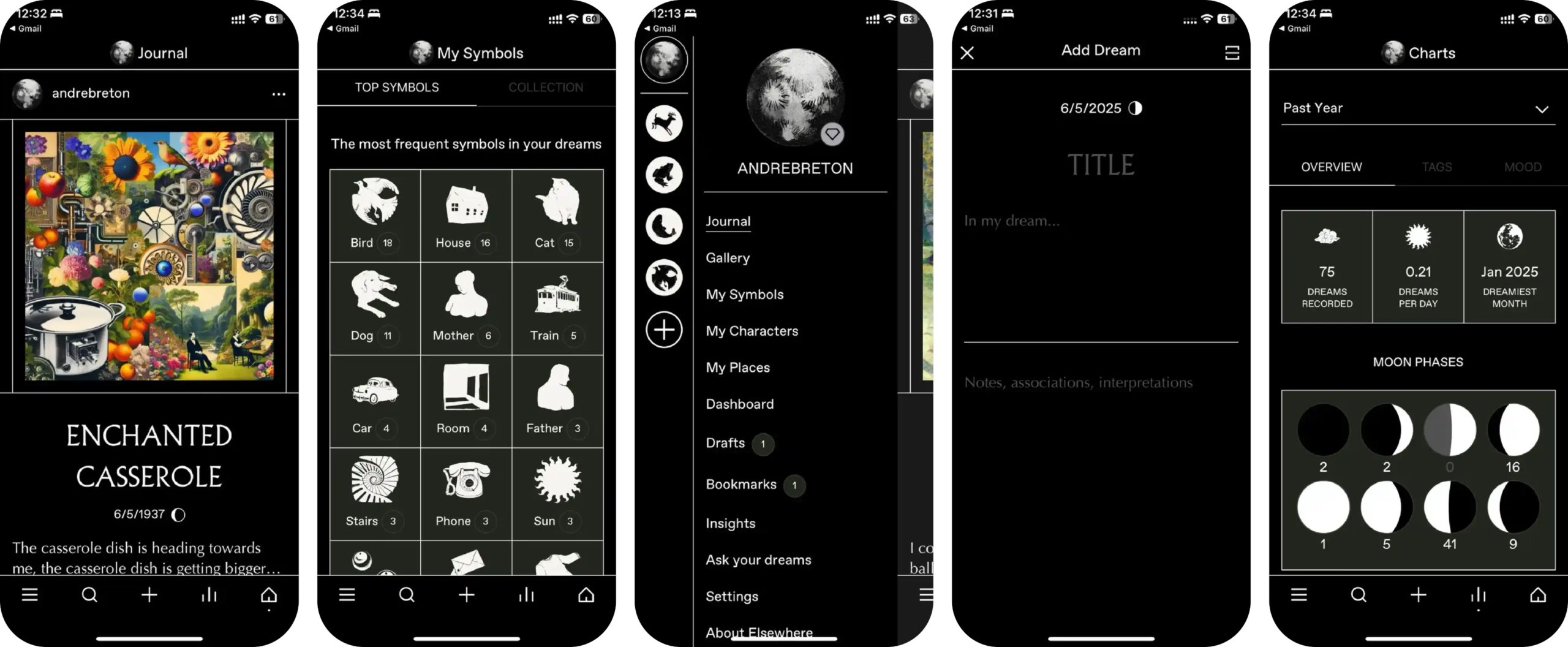
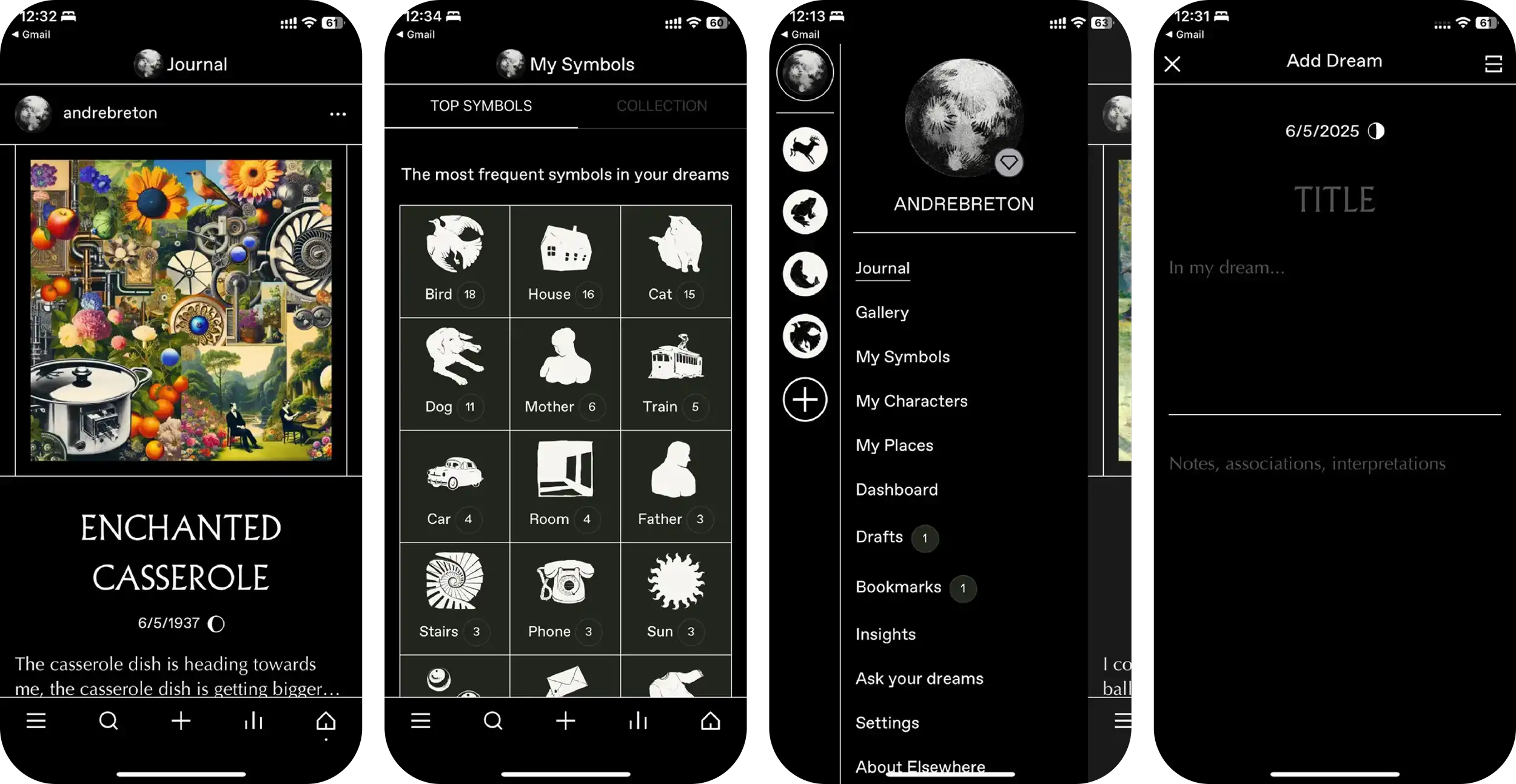
Elsewhere is the most aesthetically intentional app on this list. Its screens are styled as pages from a handmade book, its illustrations are hand-drawn, and the overall experience feels like you are filling a private sketchbook, not a database. It is designed as an artistic, visual dream log, making it a great choice for creative dreamers.
But the interpretations, beautiful as they are, do not account for who you are. There is no profile, no psychological intake, no history of who the dreamer is beyond the last few entries. It will tell you what water means. It won’t tell you why you, specifically, keep dreaming of water right now.
Compared to Mirror: Elsewhere makes journaling feel beautiful. Mirror makes it feel useful. If your goal is ritual and aesthetics, Elsewhere. If your goal is insight, Mirror.
Pros
- Stunning, book-like visual aesthetic that makes writing feel like a ritual.
- Generous free tier with 15 free AI images and interpretations per month.
Cons
- No advanced lucid dreaming features.
- UI transitions can occasionally feel sluggish.
- Interpretations do not take personal life history into account.
Platforms, Pricing & Vibe
- Platforms: iOS, Android
- Pricing: Free (15 AI features/month) | Premium: $4.99/month · $49.99/year
- Vibe: The hardcover journal.
Who It’s For
Best for writers and aesthetic lovers who prefer a quiet, book-like interface for morning logging. It functions as a minimal dream journal app focused on clean typography and aesthetic visual generation rather than therapeutic inner work.
7) Everi
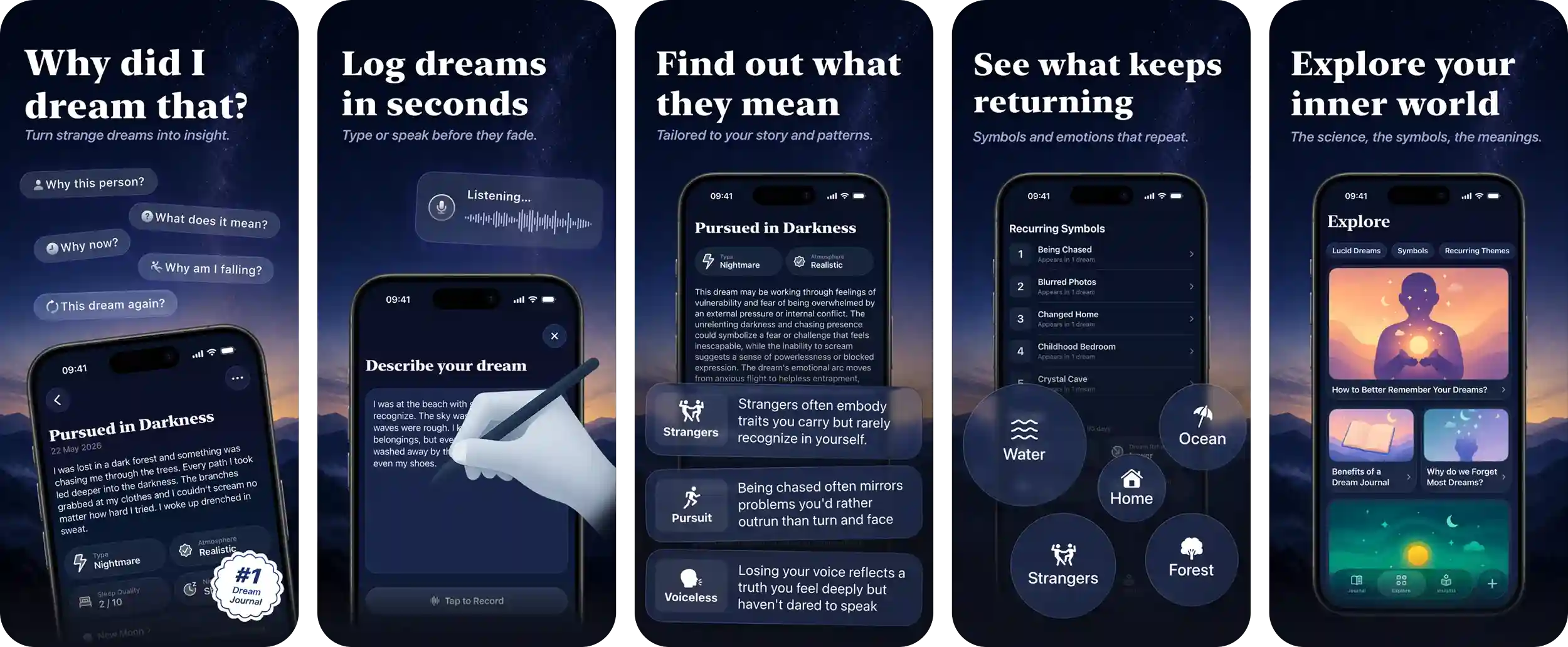
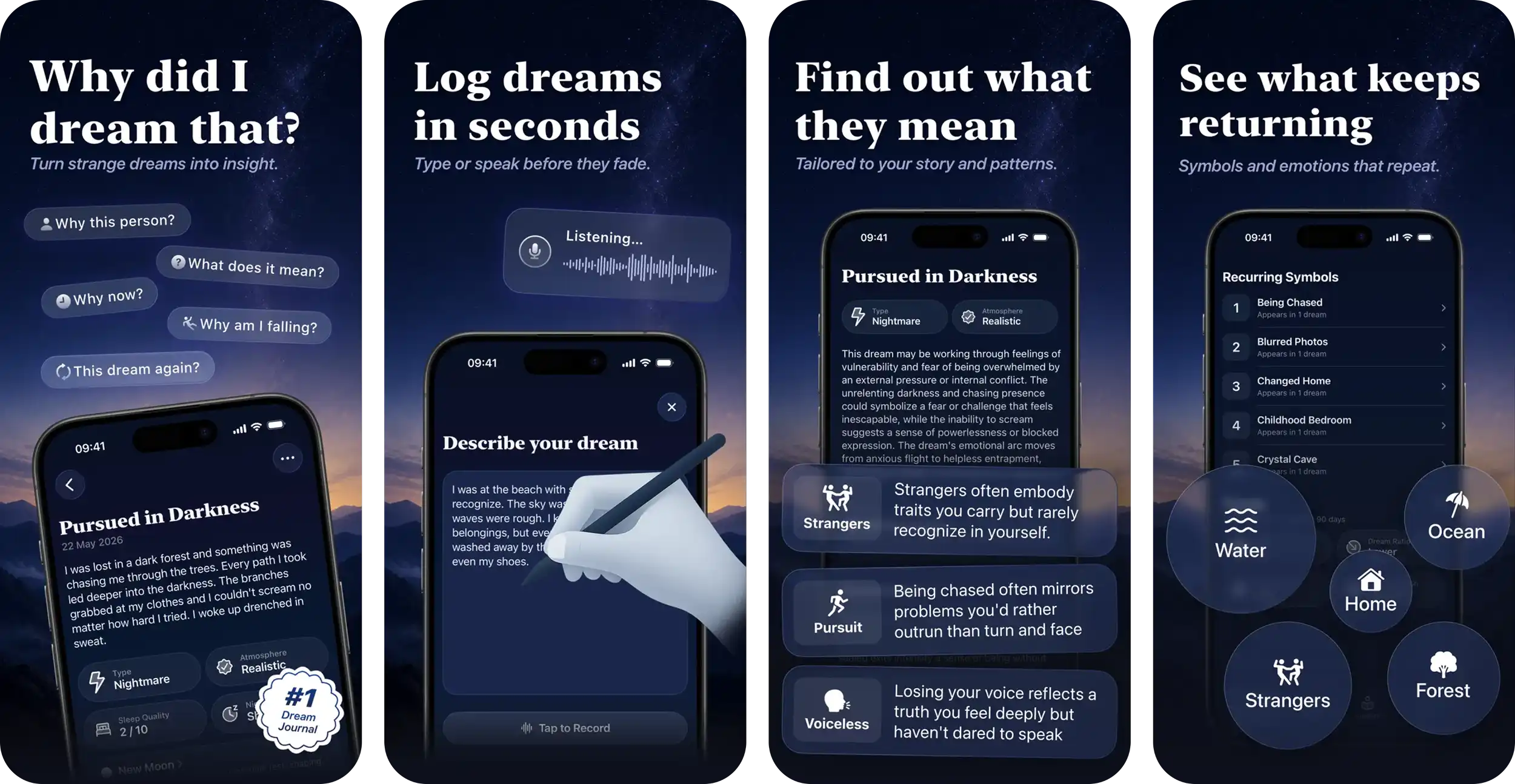
Everi is a clean, iOS-exclusive dream tracking app that features a visual Dream Map dashboard. It offers fast voice dictation for immediate waking logging and tracks recurring emotional tags across your entries over time.
While Everi provides slick trend charts, its AI analyzes dream text in isolation. It lacks a structured intake profile to account for your personal history or key relationships. Android users are also excluded due to its iOS exclusivity.
Pros
- Fast voice-to-text recording.
- Interactive Dream Map visual insights.
Cons
- No Android version available.
- Interpretations lack personal life history context.
Platforms, Pricing & Vibe
- Platforms: iOS
- Pricing: Freemium | Premium subscription
- Vibe: The visual trend dashboard.
Who It’s For
Ideal for iPhone users looking for an iOS dream journal app with fast voice dictation and visual emotion tracking charts. It appeals to mobile journalers who want colorful trend maps on Apple devices.
8) Temenos Dream
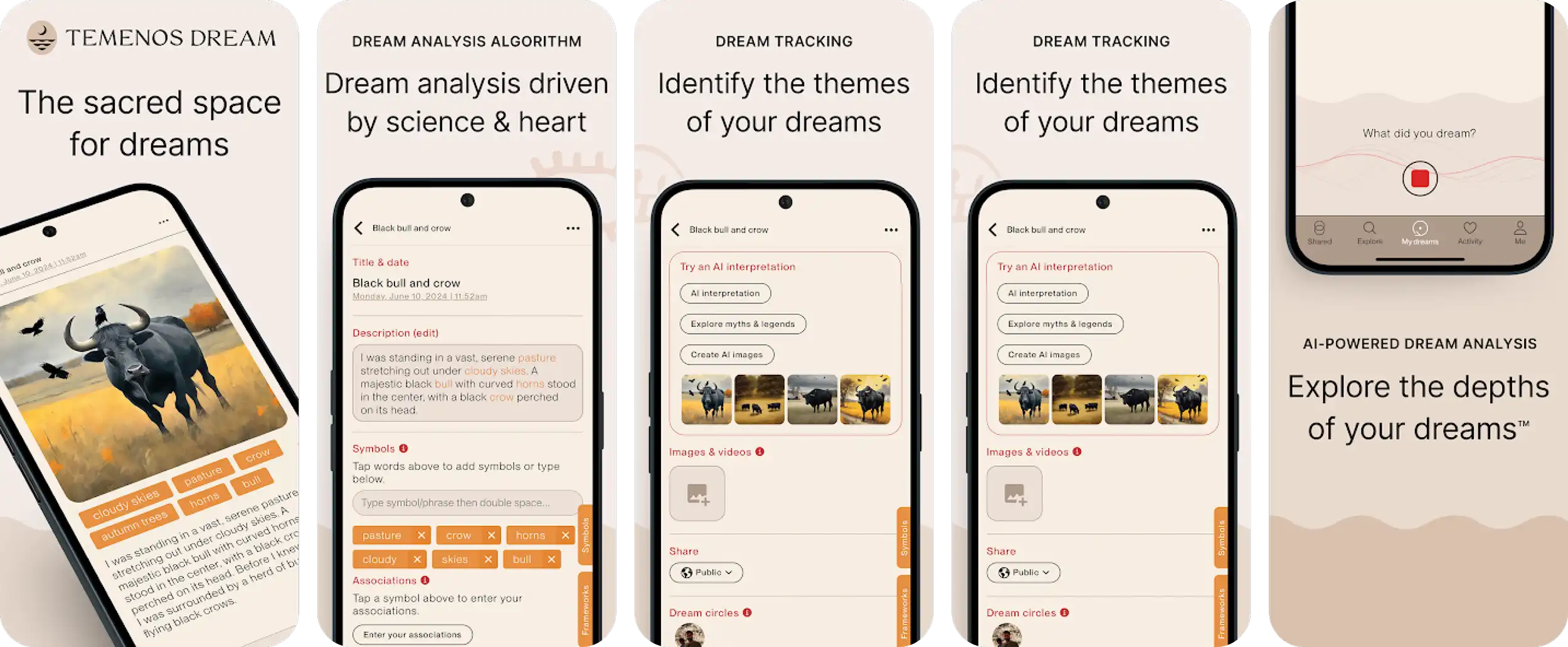
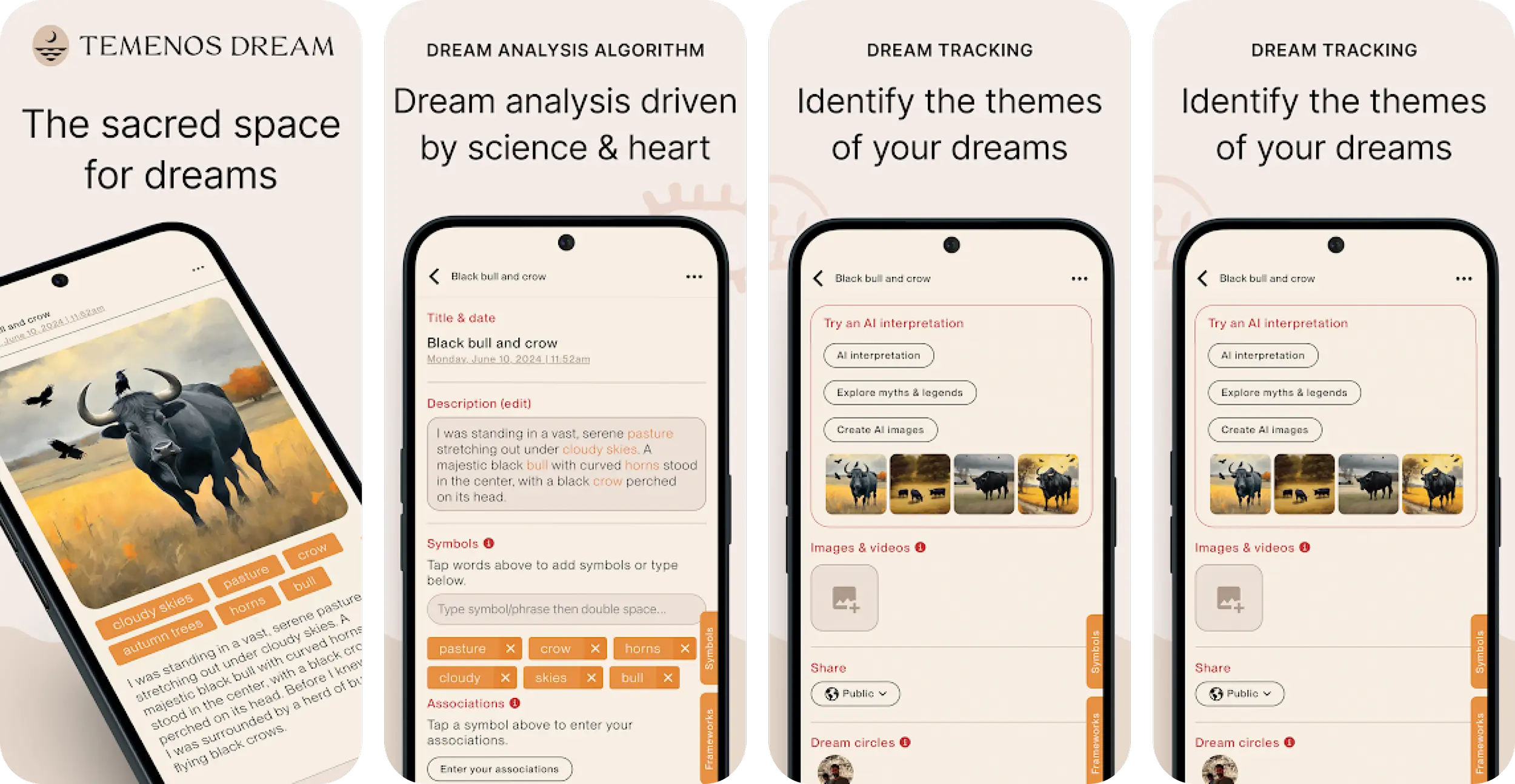
Temenos Dream is designed specifically for Jungian archetypal analysis and depth psychology. It allows users to map dream symbols directly to classic Jungian motifs, offering a thoughtful space for symbolic self-reflection.
However, Temenos focuses heavily on academic archetype lookups rather than active therapeutic exercises. Without a personalized intake profile, it cannot connect recurring symbols to your real-life waking struggles.
Pros
- Rich Jungian symbol mappings.
- Thoughtful depth psychology framework.
Cons
- Lacks personalized user profile context.
- No nightmare rescripting or active imagination tools.
Platforms, Pricing & Vibe
Who It’s For
Perfect for depth psychology students seeking a specialized dream interpretation app centered on C.G. Jung’s archetypal framework. It fits users interested in cataloging symbolic motifs and classic psychological mythologies.
9) DreamApp
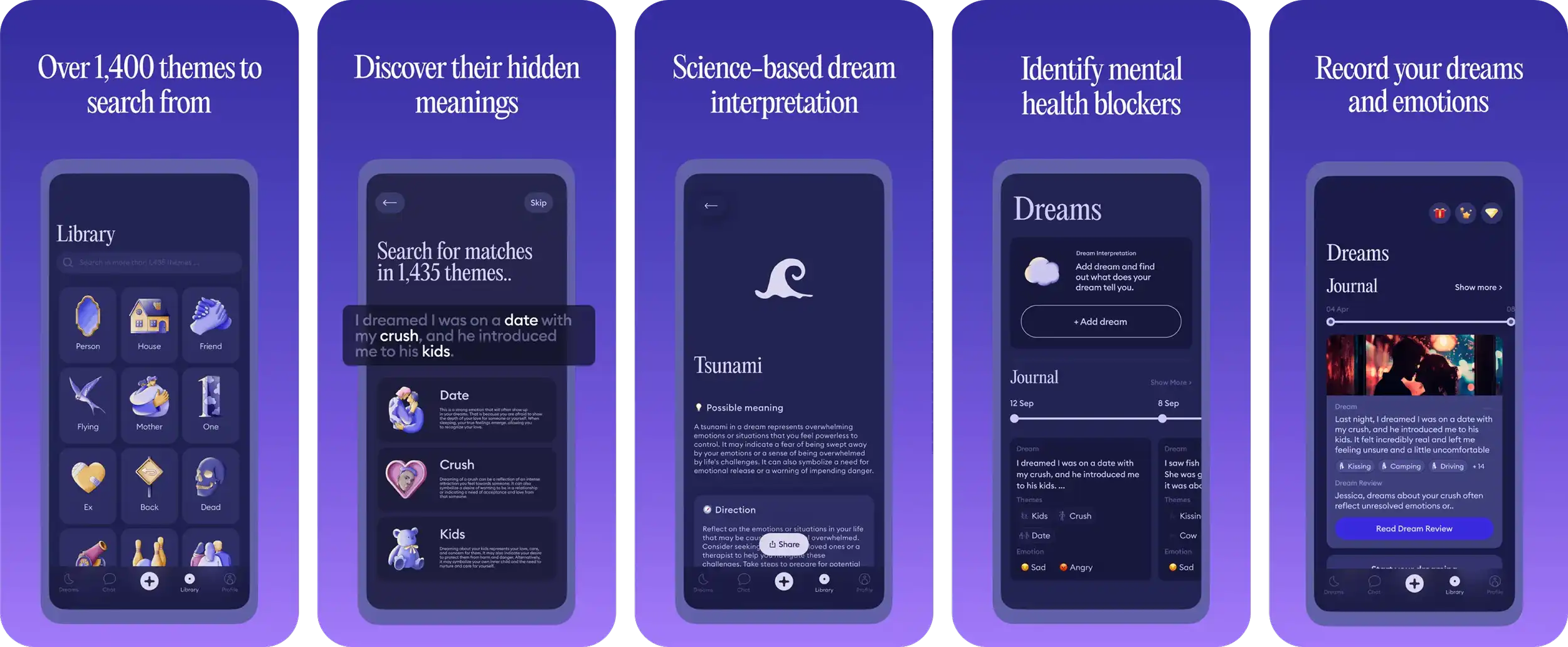
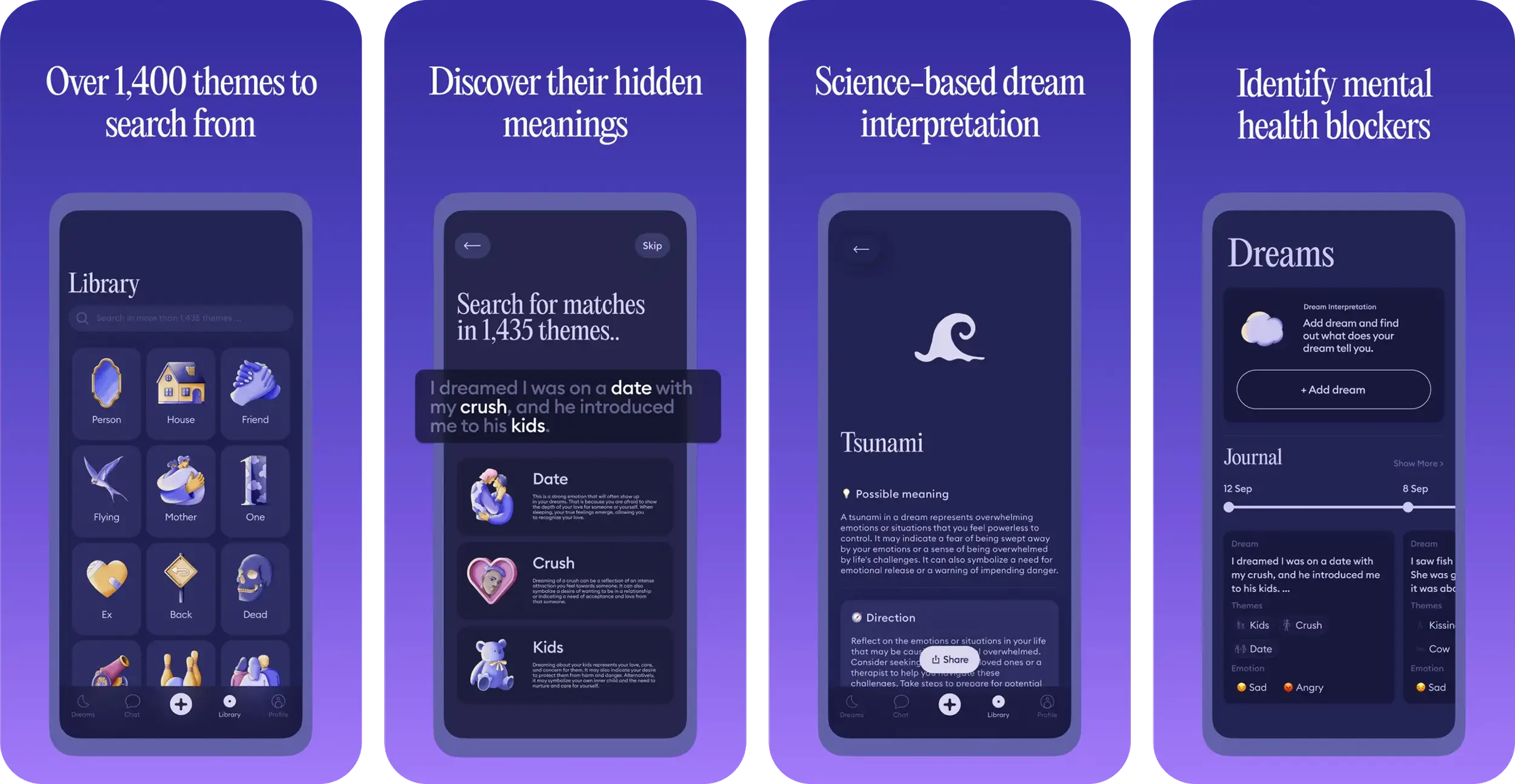
DreamApp is one of the most widely advertised dream interpretation tools on mobile app stores. It pairs AI analysis with an optional paid connection to professional human therapists for deeper consultations.
Despite its popularity, the AI interpretations rely heavily on generic dictionary definitions. Its subscription fees escalate quickly if you want access to advanced insights or human chat options.
Pros
- Polished commercial interface.
- Optional therapist consultation access.
Cons
- Generic AI symbol interpretations.
- High subscription cost.
Platforms, Pricing & Vibe
- Platforms: iOS, Android
- Pricing: Subscription required for core AI features
- Vibe: The commercial clinic.
Who It’s For
Geared toward casual users wanting a commercial dream interpretation app with quick symbol lookups and optional paid access to human therapists. It serves as a mainstream entry point for general dream questions.
10) Lucidity
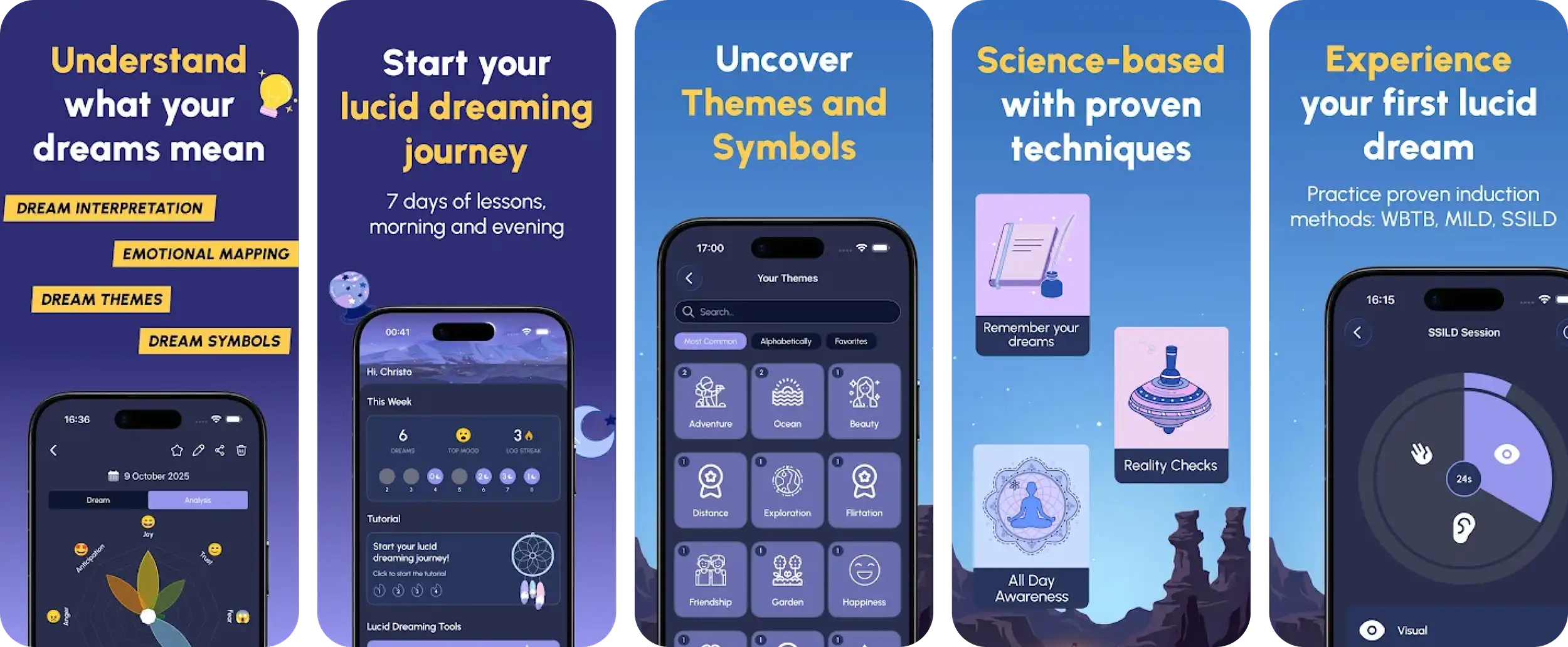
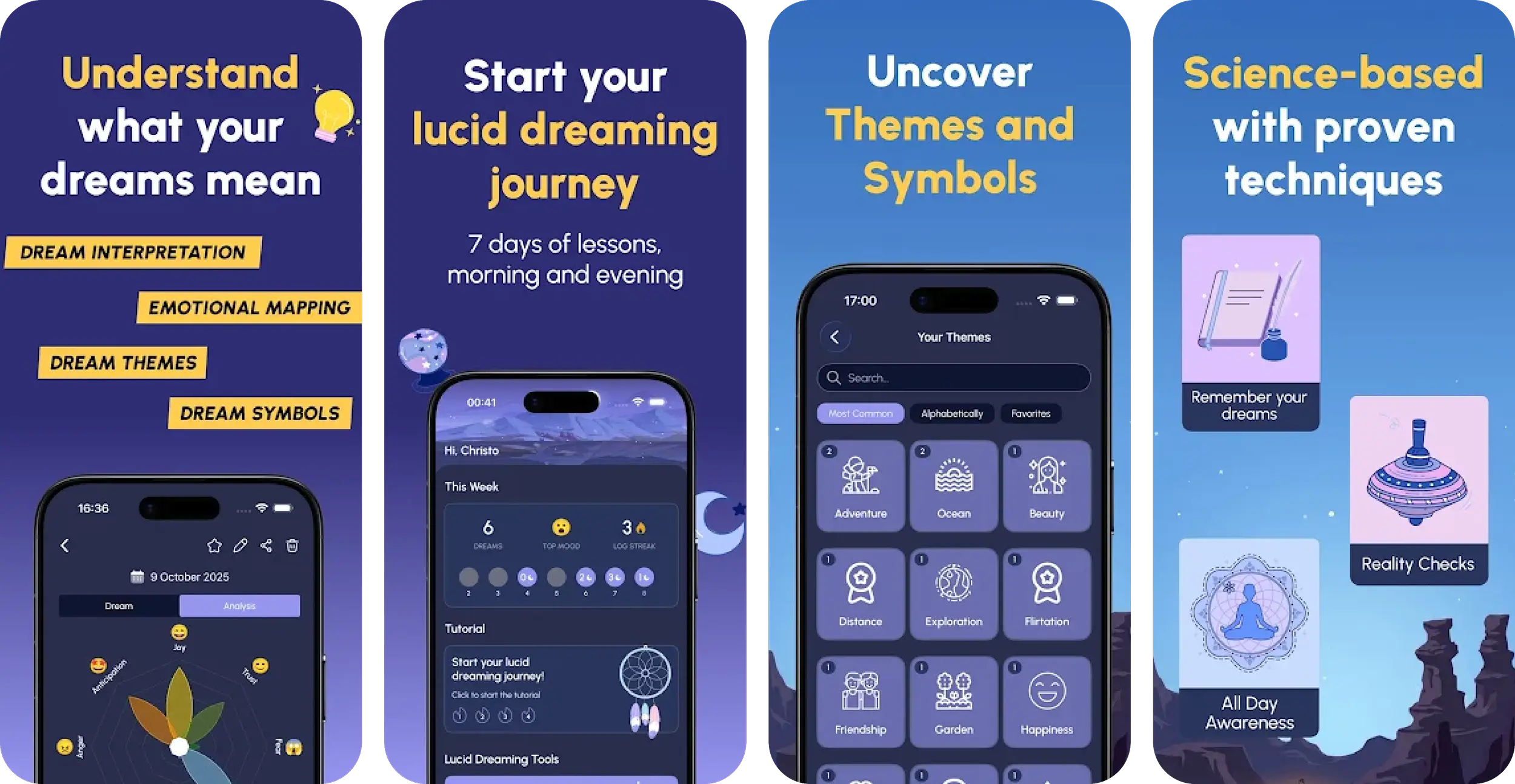
Lucidity is a dedicated lucid dreaming companion designed to help users achieve consciousness inside their dreams. It includes reality check reminders, dream sign tagging, and audio induction cues.
Lucidity excels as a technical training cockpit for lucid dreamers. However, it does not offer deep psychological profiling or personalized AI analysis for waking emotional growth.
Pros
- Effective reality check scheduling.
- Detailed dream sign tracking.
Cons
- No personalized psychological AI analysis.
- Limited focus on waking self-discovery.
Platforms, Pricing & Vibe
- Platforms: Android
- Pricing: Freemium
- Vibe: The lucid training cockpit.
Who It’s For
Built for Android and iOS lucid dreaming practitioners who need customizable reality check notifications and dream sign tracking. It provides a technical cockpit for lucid induction techniques.
11) DreamWell
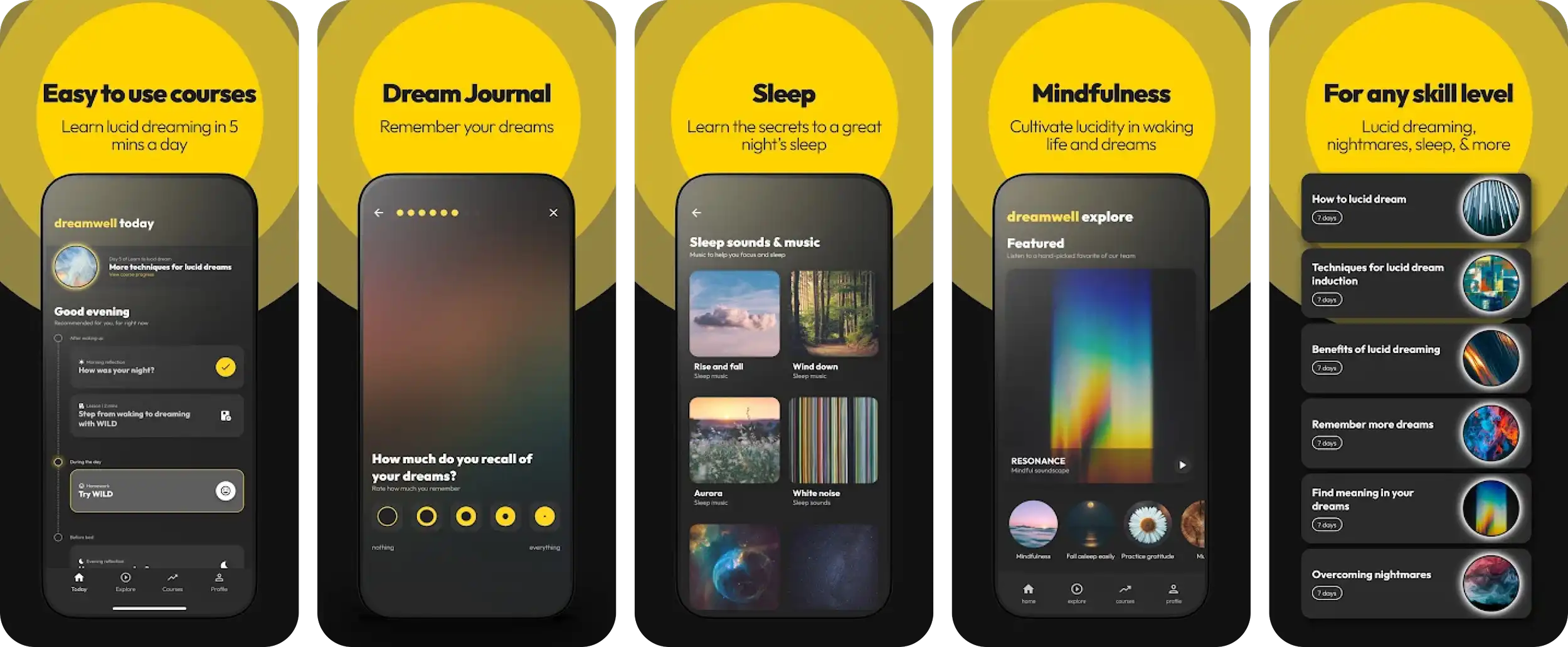
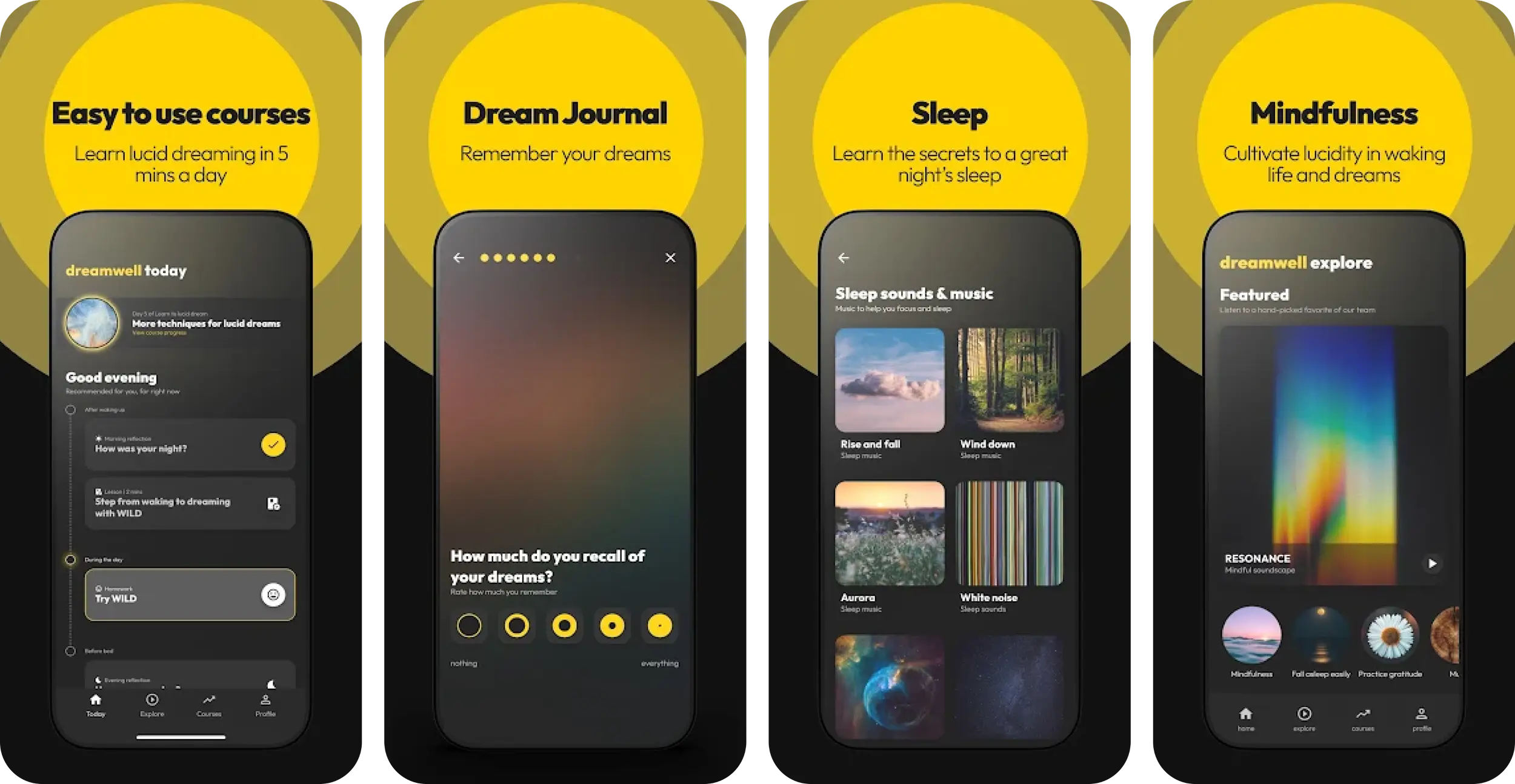
DreamWell combines dream logging with guided mindfulness lessons, sleep hygiene courses, and lucid dreaming techniques. It provides a holistic health approach to sleep and dreaming.
While its educational courses are valuable, DreamWell functions primarily as a general wellness app. It lacks dedicated psychological profile integration to decode complex recurring dreams.
Pros
- Quality sleep and mindfulness courses.
- Clean wellness interface.
Cons
- Lacks context-aware AI interpretation.
- Requires paid subscription for full lessons.
Platforms, Pricing & Vibe
Who It’s For
Suited for individuals seeking a wellness-focused dream journal app that combines basic logging with mindfulness courses, sleep hygiene lessons, and guided meditations for better sleep health.
12) Dreamboard
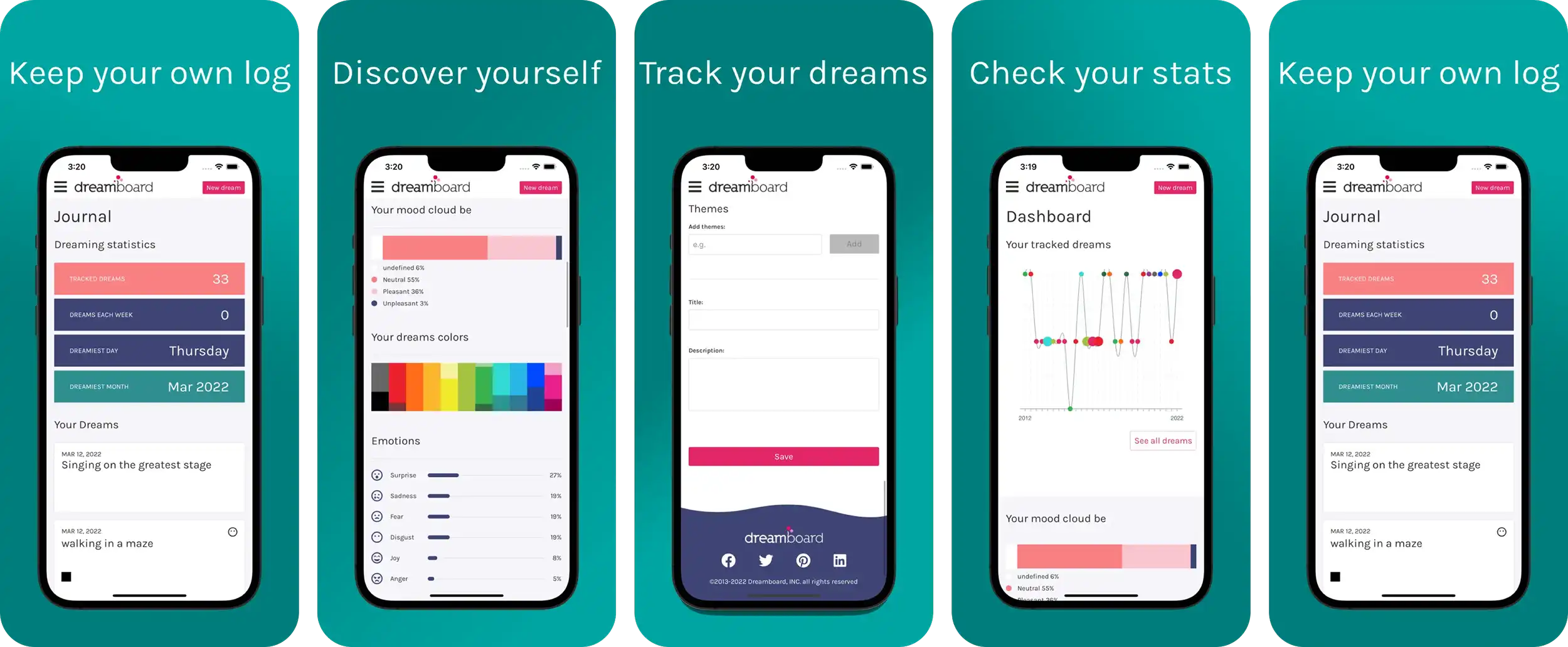
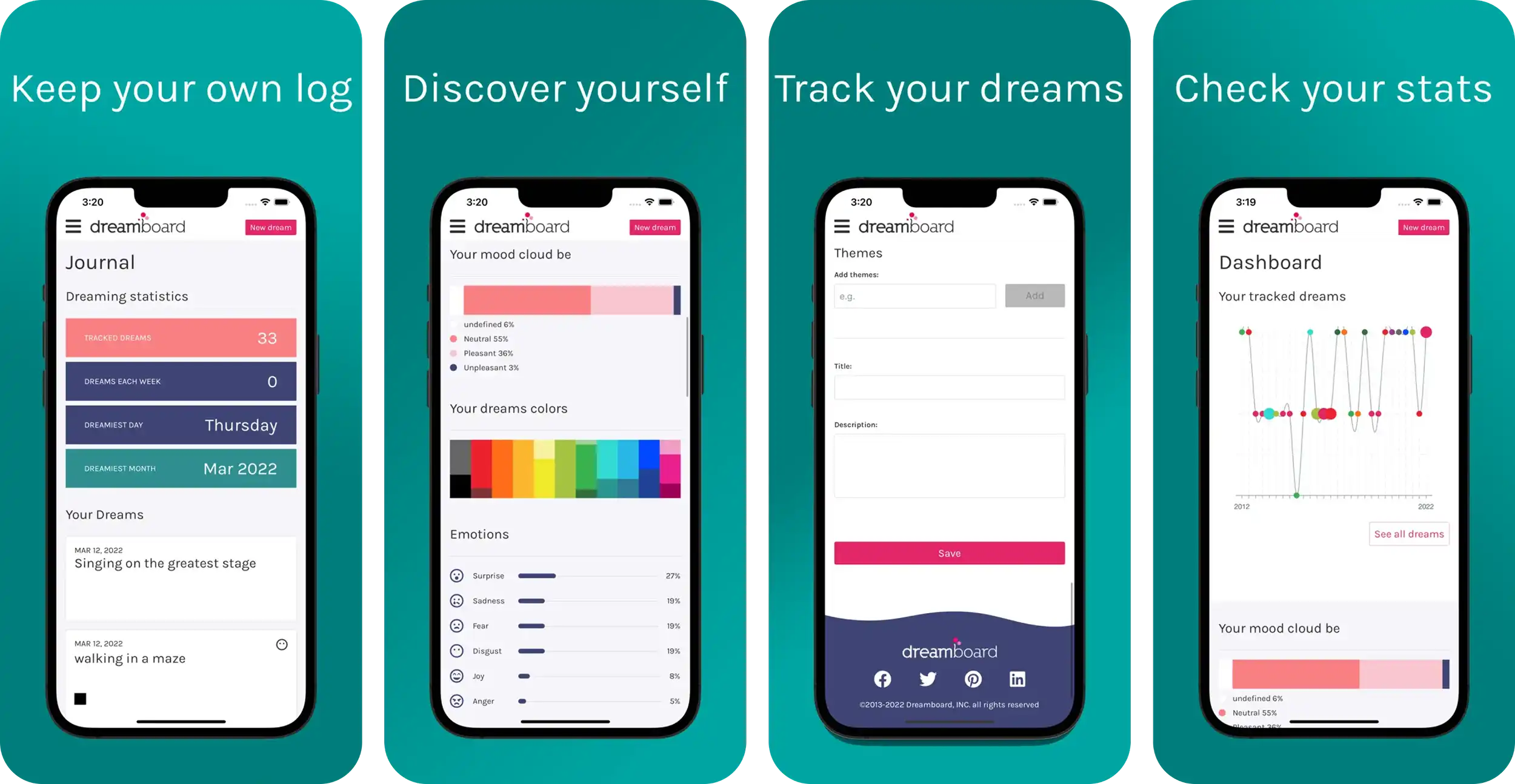
Dreamboard was one of the earliest digital dream trackers launched in the 2010s. It introduced structured emotion tags and intensity sliders, paving the way for modern digital journaling.
However, Dreamboard is now a legacy tool with minimal developer maintenance. Users frequently report sync errors and data loss risks, making it unsafe for long-term journal storage.
Pros
- Pioneered early emotion intensity tracking.
Cons
- Unmaintained with serious data loss risks.
- No modern AI capabilities.
Platforms, Pricing & Vibe
Who It’s For
Relevant primarily for historical research into early 2010s digital journaling tools. Because it is unmaintained, active users seeking a secure dream journal app should opt for modern active platforms instead.
13) Dream Journal Ultimate
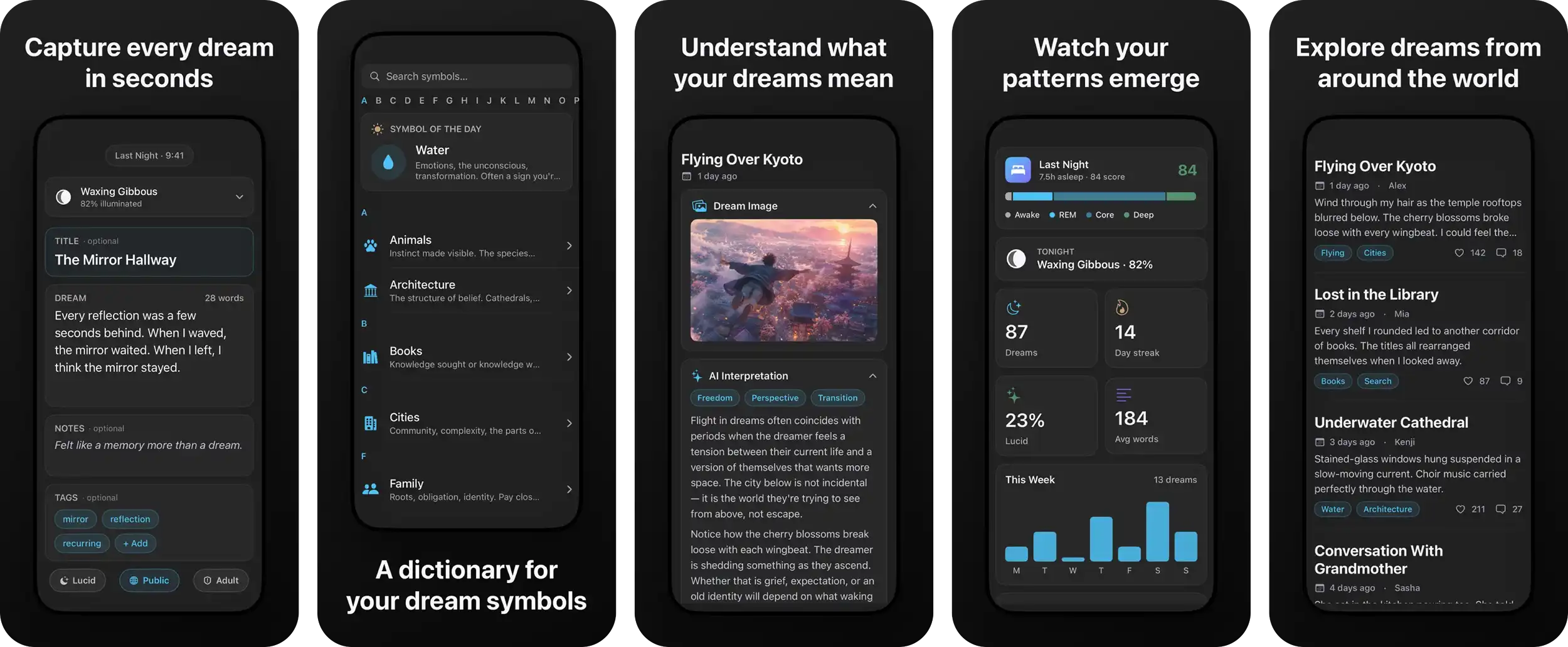
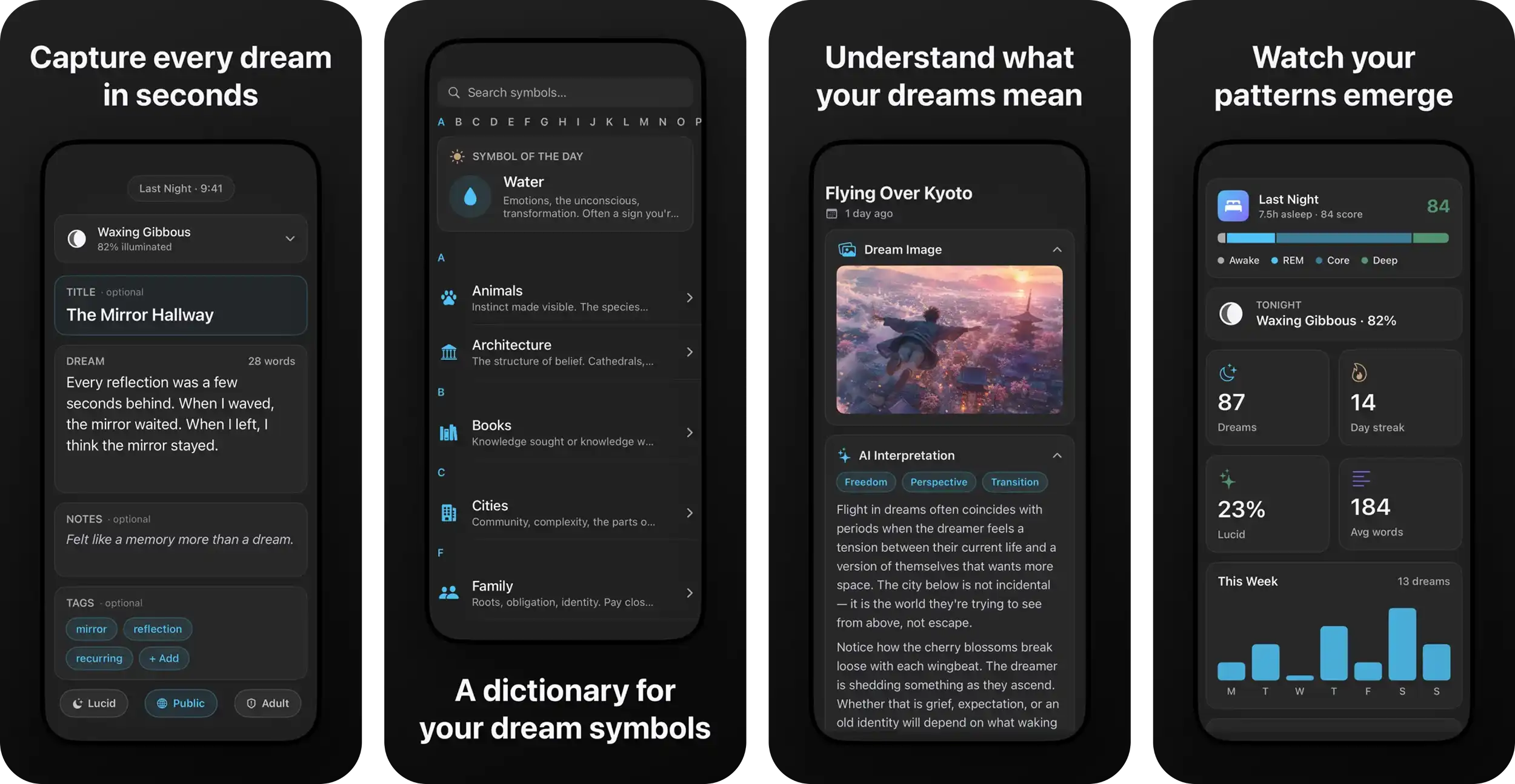
Dream Journal Ultimate is a long-standing community app centered around its public Dream Wall, where users post entries and read community feedback from around the world.
While the social aspect is unique, public sharing compromises privacy by default. The interface feels dated, and interpretations rely on crowdsourced comments rather than grounded psychological AI.
Pros
- Active public “Dream Wall” community.
- Free tier available.
Cons
- Public focus compromises journal privacy.
- Dated user interface.
Platforms, Pricing & Vibe
Who It’s For
Designed for social dreamers who want a community-focused dream journal app with a public Dream Wall for sharing entries and reading global user comments.
14) DreamMuse
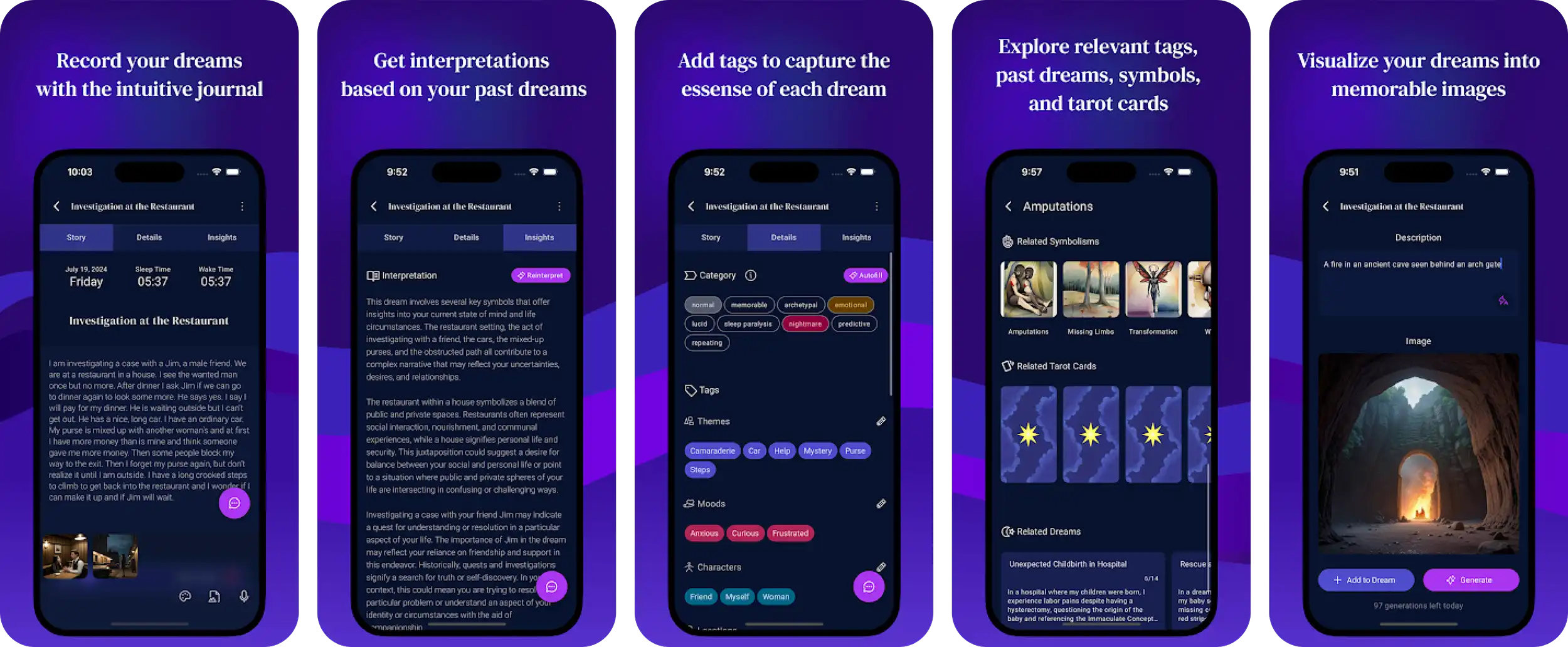
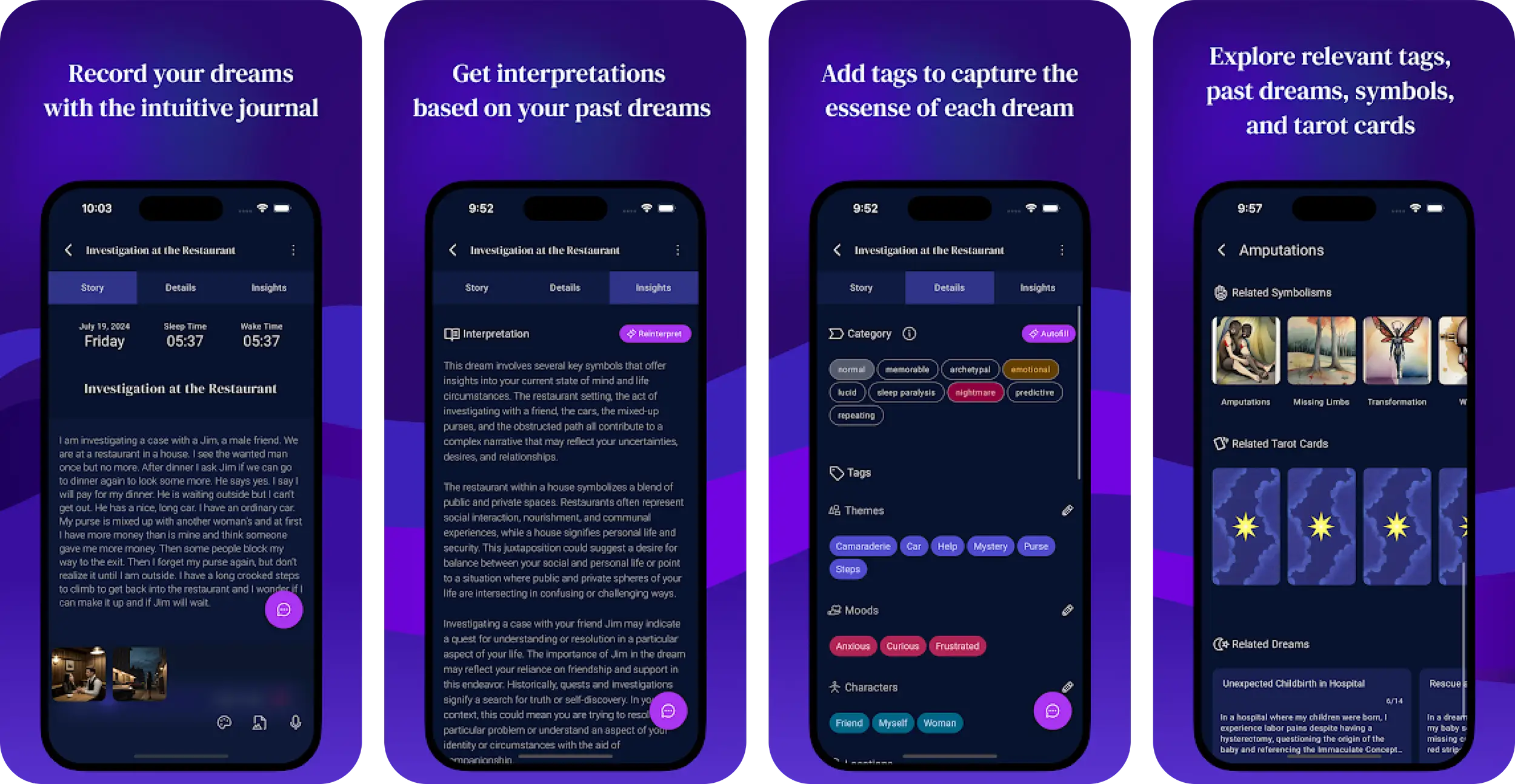
DreamMuse is an emerging AI dream journal that focuses on chat-based reflection and recurring symbol discovery. It provides an intuitive interface for logging morning thoughts and reviewing past entry summaries.
While DreamMuse offers engaging chat features, its AI operates without a dedicated personal intake profile. It cannot connect dream symbols to your waking relationships, history, or active psychological struggles.
Pros
- Intuitive conversational AI interface.
- Clean recurring symbol tags.
Cons
- Lacks personal user profile context.
- No active therapeutic inner work exercises.
Platforms, Pricing & Vibe
Who It’s For
Tailored for users looking for an interactive dream interpretation app with conversational AI chat reflections and simple recurring symbol tags.
15) Dreams: Your Dream Journal
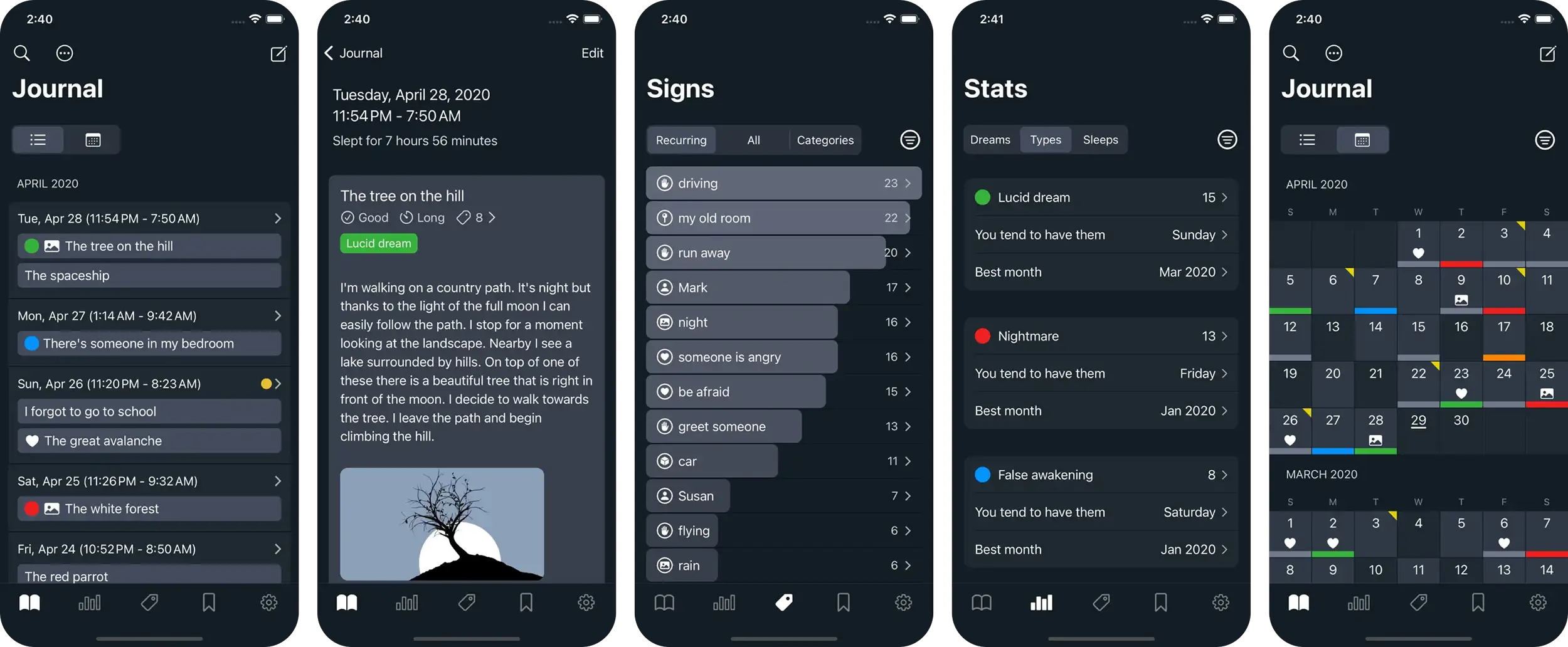
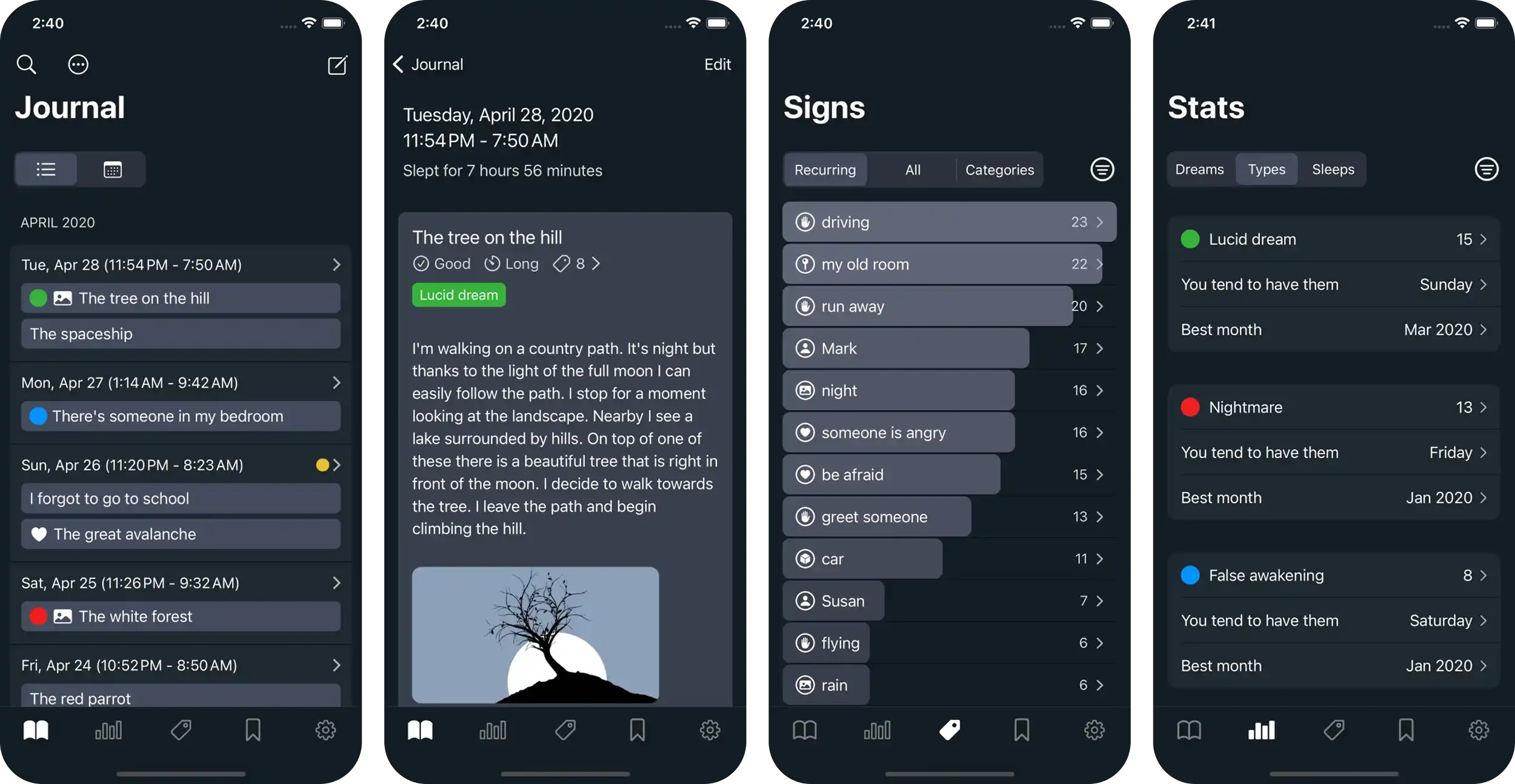
Dreams: Your Dream Journal is a long-standing iOS dream tracking app designed for fast iPhone logging, tag categorization, and basic symbol lookups.
While Dreams offers a clean iOS experience and biometric security, its symbol interpretations rely on generic definitions. It lacks a structured personal intake profile and provides no active therapeutic tools for nightmare resolution.
Pros
- Clean iOS interface with biometric lock.
- Simple tag organization.
Cons
- iOS-only (no Android support).
- Generic AI interpretations without personal context.
Platforms, Pricing & Vibe
- Platforms: iOS
- Pricing: Freemium | In-app purchases
- Vibe: The classic iPhone dream log.
Who It’s For
Built for iPhone users seeking a classic, passcode-protected iOS dream journal app for simple morning text entries and tag categorization.
Frequently Asked Questions
What is the best dream journal app overall?
What is the best dream journal app overall?
For depth, personalization, and long-term self-discovery, Mirror is the best overall choice. It is the only app that contextualizes every interpretation based on your actual psychological profile. For lucid dreaming specifically, Oniri is the most refined tool. For aesthetics and artistic visual design, Elsewhere is the best option.
Is AI dream interpretation accurate?
Is AI dream interpretation accurate?
AI interpretations are not diagnoses, they are mirrors. The quality of the reflection depends entirely on how much the AI knows about you. Generic AI interpretations are accurate in the same way that horoscopes are accurate: they are designed to resonate with almost anyone. Profile-driven AI, like Mirror’s, is accurate in a more meaningful sense: it is specific.
Are dream journal apps private?
Are dream journal apps private?
Only if the app offers biometric locks, a no-sale data policy, and easy export. Before trusting any app with your inner world, verify all three.
What is the best free dream journal app?
What is the best free dream journal app?
Elsewhere offers the most generous free tier for general use. Mirror’s free tier (one AI interpretation per day) is the best free entry point for those focused on personalized insight.
Can an app help me remember my dreams?
Can an app help me remember my dreams?
Yes, but only if it builds the habit. Apps like Mirror that include pre-sleep meditations, morning prompts, and a recall training program produce significantly better results than apps that are simply passive journals.
Quick Match: Find Your App in 30 Seconds
| What you want | Best pick | Vibe |
|---|---|---|
| Deep, personalized self-discovery | Mirror#1 Choice | Introspective |
| Lucid dreaming training | Oniri | Technical |
| Beautiful artistic design | Elsewhere | Literary |
| Multiple psychological frameworks | Hypnos | Academic |
| Fast voice capture + visual storytelling | DreamStream | Fluid |
| Whole-life reflection, not just dreams | Know Your Ethos | Holistic |
Why a Dream Journal App Is So Important
A dream journal app is more than a digital notebook. It is a direct doorway to explore your inner world and understand your subconscious mind. Over 90 percent of dream details dissolve within ten minutes of waking. Instant morning dictation and pre-sleep intention settings preserve vital psychological material before it vanishes into waking distraction.
1. Instant Morning Capture Before Memories Dissolve
Physical notebooks require reaching for a pen and turning on bright lights, which breaks the delicate bridge between dream memory and waking consciousness. A dedicated app lets you record vivid audio transcriptions while remaining still in bed, capturing subtle emotional nuances before waking logic rewrites them.
2. Organized Memory and Long-Term Pattern Tracking
Paper journals and basic text tools store entries as disconnected pages. Mirror maintains an organized memory of all your past dreams alongside the exact personal insights discovered in previous logs. As your journal grows, the profile engine aggregates your entries across emotional shifts, symbol frequency, vividness, and recurring narrative themes.
3. Personalized Context Versus Generic Dictionaries
Static online dictionaries treat symbols in a vacuum, giving one-size-fits-all definitions that ignore who you are. Mirror connects dream symbols to your actual life history, personal relationships, waking struggles, and core personality traits. This ensures your analysis reflects your lived reality rather than generic web stereotypes.
4. Highly Accurate Interpretations for Deep Self-Discovery
Because Mirror maintains this structured historical memory, it functions as the best dream interpretation app for serious self-discovery. Instead of delivering superficial lookups, Mirror evaluates every new symbol against your evolving life context. This cumulative psychological context produces dream interpretations that are highly accurate, enabling you to understand yourself deeply.
5. Therapeutic Nightmare Resolution and Inner Peace
Waking up with lingering anxiety from recurring nightmares can disrupt your entire day. Mirror moves beyond passive record-keeping by offering structured therapeutic exercises like Nightmare Rescripting, Active Imagination, and Free Association. These evidence-based tools help you process subconscious tension, rewrite terrifying scenarios, and achieve genuine emotional resolution.
The Test That Shows You the Difference
To illustrate why personalization matters, we logged the exact same dream across four different AI dream apps and recorded the response.
The Logged Test Dream“I am standing in my childhood kitchen. The floor is slowly turning into deep blue ink.”
#1 Generic AI Dream App • Surface Level
“Blue represents sadness or calm. Ink can symbolize communication. Your childhood home suggests a desire to return to safety. This dream may indicate unresolved feelings from your past.”
Assessment: Technically plausible. Could apply to literally anyone.
#2 Multi-Framework App • Academic
“Jungian view: the kitchen, as a place of transformation and nourishment, may represent your individuation process. Blue ink as a medium of expression suggests an emerging need to articulate unconscious material.”
Assessment: More interesting. Still impersonal.
#3 Visual Storytelling App • Visual Only
Generated a striking comic panel of a blue-flooded kitchen. “Your subconscious is painting a scene of emotional overflow in a familiar space.”
Assessment: Beautiful and evocative. Doesn’t go deeper.
This is what profile-driven AI means in practice. The first three apps answered the question. Mirror answered your question.
Final Word
The best dream journal app in 2026 is not the one with the most features. It is not the most beautiful one. It is the one that, six months from now, makes you feel like you understand yourself better than you did before.
Every app on this list has something worth offering. But only one is built around a single, uncompromising principle: your dreams are not generic, and your interpretations shouldn’t be either.
If you are ready for the kind of self-discovery that requires honesty, patience, and a willingness to look at what your subconscious keeps bringing up : Mirror is where to begin.
Full Disclosure: We are the creators of Mirror. We have evaluated it here alongside genuine competitors with the goal of helping you make the best choice for your practice : not just for us.